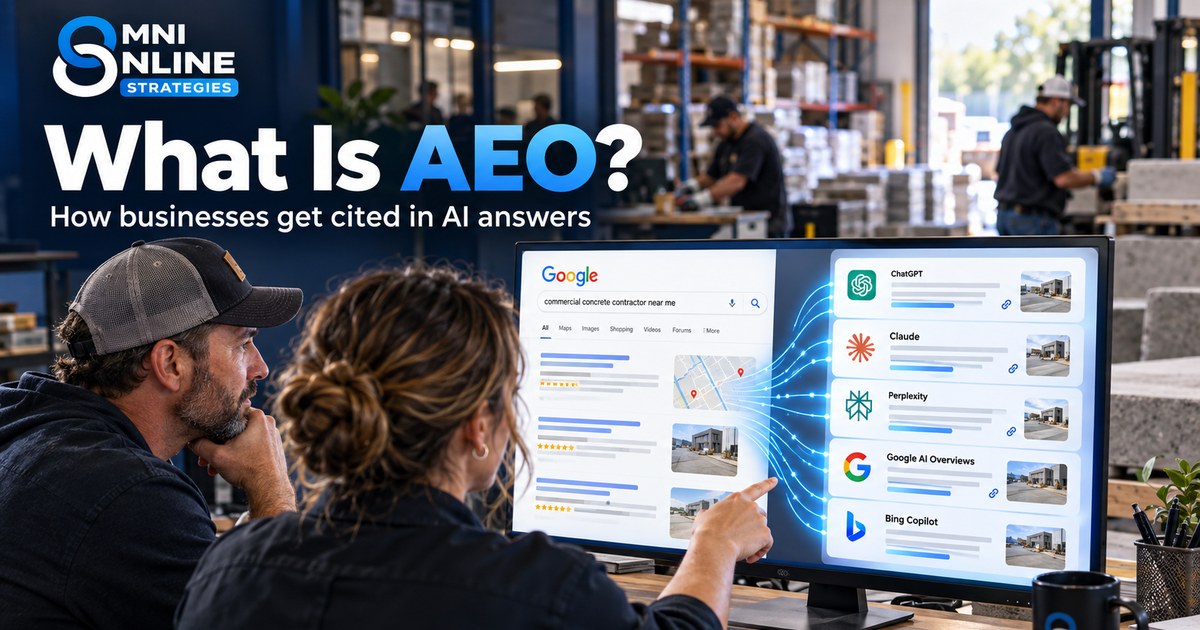
Answer engine optimization (AEO) is the practice of structuring your content and your presence across the web so AI answer engines, such as ChatGPT, Google AI Overviews, Perplexity, Gemini, and Claude, can find it, trust it, and quote it in the answers they give. The bottom line: answer engine optimization builds on SEO fundamentals, adds work on how passages are structured and how other sites corroborate you, and has to be judged by how often AI answers name you across many runs, because no one controls what an assistant says.
Where answer engine optimization comes from
SEO as a term dates to 1997. For two decades the goal stayed the same: rank higher and earn the click. Then search began answering questions itself. Google announced its Knowledge Graph in May 2012 and added featured snippets in 2014, which created zero click searches years before AI. OpenAI launched ChatGPT in November 2022 and ChatGPT search in October 2024, and Google began running AI Overviews regularly in May 2024. Marketers needed a name for the new goal, being quoted inside an answer, and the label answer engine optimization is commonly traced to the earlier featured snippet and voice assistant work. GEO, generative engine optimization, is its academic sibling, and the two are used almost interchangeably in practice.
Why answer engine optimization matters now
| Evidence | Source |
|---|---|
| 68% of US Google searches ended without a click to anywhere in the first four months of 2026, up from 58.5% in 2024 | SparkToro, using different clickstream panels, so compare with care |
| Users clicked a traditional result in 8% of visits with an AI summary against 15% without, and a link inside the summary in 1% | Pew Research, 900 US adults, March 2025 |
| 51% of B2B software buyers start research in an AI chatbot more often than in Google | G2, March 2026, 1,076 buyers |
| 45% of consumers used AI for local business recommendations in the past year, up from 6% | BrightLocal 2026, 1,002 US adults |
Answer engine optimization, SEO, and GEO compared
The three terms overlap, and each stresses a different part of the work. Wikipedia lists answer engine optimization and artificial intelligence optimization as other names for generative engine optimization, which shows how loosely the labels are used.
| SEO | Answer engine optimization (AEO) | GEO | |
|---|---|---|---|
| Goal | Rank a page in a list of results and earn the click | Be the source an answer engine quotes or names | Raise your visibility in generated answers |
| Unit that wins | The page | The passage or answer block | The source cited inside the answer |
| Success measure | Rankings, clicks, traffic | Mentions, citations, share of answers | Visibility metrics in generated responses |
| Origin of the term | 1997 | Industry term, traced to featured snippet and voice work | Named in a November 2023 paper (arXiv 2311.09735) from Princeton, Georgia Tech, the Allen Institute for AI, and IIT Delhi, published at KDD 2024 |
In practice one program covers all three. A page that is crawlable, well written, and trusted ranks in classic search, gets quoted in answers, and can be measured on both. Our guide on answer engine optimization vs generative engine optimization covers the differences in more depth.
Which answer engines matter
Each major answer engine finds sources differently, and the rules are published, which makes the first step concrete.
| Answer engine | How it finds sources | What to check |
|---|---|---|
| Google AI Overviews and AI Mode | Google's Search index. A page must be indexed and eligible to show with a snippet, and Google says there are no additional technical requirements | Indexing, snippet settings, helpful content |
| ChatGPT search | OpenAI's OAI-SearchBot surfaces sites in search features. Sites that opt out are not shown in ChatGPT search answers, though they can still appear as navigational links | Allow OAI-SearchBot in robots.txt |
| Perplexity | PerplexityBot supports search results, and Perplexity says it does not use it for training. Perplexity-User fetches pages for users and generally ignores robots.txt | Allow PerplexityBot |
| Claude | Anthropic runs ClaudeBot for training, Claude-SearchBot for search indexing, and Claude-User for user requests. Blocking the search bot may reduce visibility in Claude's search results | Allow Claude-SearchBot |
How to do answer engine optimization in eight steps
- Let the search crawlers in. Allow
OAI-SearchBot,Claude-SearchBot, andPerplexityBotin robots.txt. Training bots such asGPTBotandClaudeBotare a separate choice, and blocking them does not remove you from the search bots' results. Keep the content in the raw HTML, because the major AI crawlers do not run JavaScript, according to Vercel. - Be indexed and snippet eligible in Google. Google says a page must be indexed and eligible to be shown in Search with a snippet to appear in AI Overviews or AI Mode. Do not use
nosnippetornoindexon pages you want quoted, submit a sitemap, and link to important pages from other pages on your site. - Put the answer first. State the direct answer in the first 40 to 60 words of the page or section, then add detail. AirOps found 44 percent of ChatGPT citations came from the first 30 percent of a page.
- Write for the questions customers actually ask. Answer engine queries tend to be longer and more conversational than classic keywords. Use question headings, short answers under them, and a real FAQ section.
- Add numbers, quotes, and sources. In the GEO paper's benchmark, adding citations, quotations, and statistics raised visibility in generated answers by up to about 40 percent, and keyword stuffing performed about 10 percent worse than the unmodified baseline. The result holds within that benchmark, not as a guarantee for every site.
- Keep pages fresh and dated. Ahrefs found AI cited content averaged 2.9 years old, against 3.9 years for organic results. Show a published and updated date, and update the page when facts change.
- Use structured data honestly. Google says there is no special schema needed for AI Overviews or AI Mode, and that structured data should match the visible text. Keep Article, FAQ, Organization, and local business markup accurate, and do not treat it as a shortcut.
- Build corroboration outside your site. Reviews, directory listings, community threads, and reference pages are among the sources answer engines draw on. Keep your business profile, reviews, and listings consistent and current.
Answer engine optimization tools
Tools for answer engine optimization mostly measure. They run a set of prompts against ChatGPT, Gemini, Perplexity, and Google AI features on a schedule and log whether your brand is named or linked. Semrush and Ahrefs now bundle AI visibility features, HubSpot offers a free AEO grader and a paid tool, and dedicated products such as Profound, Peec AI, and Otterly.ai go deeper on prompts and sentiment. Published starting prices disagree between comparison guides, so check each vendor's pricing page. Our guide to answer engine optimization tools compares them and explains what no tool can do for you.
How to measure answer engine optimization
Pick 20 to 50 questions your customers ask, run each many times on several platforms, and record how often your business is named and cited. Single answers vary, so one run proves little: SparkToro and Gumshoe found less than a 1 in 100 chance that two responses returned the same brand list. Add referral traffic from chatgpt.com, claude.ai, and perplexity.ai in your analytics, and track branded search. Our guide on how to measure answer engine optimization walks through the method with an example.
What answer engine optimization is not
- Not a replacement for SEO. Google says the SEO fundamentals still apply, and a page must be indexed and snippet eligible to appear in its AI features.
- Not schema alone. Ahrefs found no citation lift from adding JSON LD markup to pages already cited more than 100 times.
- Not a guarantee. SparkToro and Gumshoe found less than a 1 in 100 chance that two responses returned the same brand list.
- Not an llms.txt file. Google says you do not need llms.txt or other AI specific files to appear in its AI features.
How long answer engine optimization takes
There is no fixed timeline. Technical fixes can be picked up once pages are recrawled. Building depth and outside presence is a matter of months, and freshness matters: Ahrefs found AI cited content averaged 2.9 years old against 3.9 years for organic results.
Go deeper on answer engine optimization
- Answer engine optimization checklist: 30 checks in five groups
- Answer engine optimization for small business
- How to get cited by ChatGPT
- How to show up in Google AI Overviews
- Answer engine optimization examples, with before and after rewrites
- Answer engine optimization tools
- How to measure answer engine optimization
- Answer engine optimization vs generative engine optimization
Questions people ask
What is answer engine optimization?
The practice of making content easy for AI answer engines to find, understand, and quote, so a business appears inside AI answers as well as in ranked links.
How do I do answer engine optimization?
Allow the AI search crawlers, make sure pages are indexed and snippet eligible, put the direct answer first, answer real customer questions, add numbers and sources, keep pages dated and fresh, use structured data honestly, and build mentions and reviews outside your site. Then measure your share of answers.
Is AEO the same as GEO?
They overlap and are often used interchangeably. GEO has a specific academic origin in the 2023 Princeton, Georgia Tech, Allen Institute, and IIT Delhi paper, while AEO is a broader industry term.
Does AEO replace SEO?
No. Google says SEO fundamentals still apply to its AI features, and a page must be indexed and snippet eligible to appear.
Do I need llms.txt for answer engine optimization?
Google says you do not need llms.txt or other special AI files to appear in its generative AI search features.
Which AI crawlers should I allow?
To be eligible for search answers, allow OAI-SearchBot for ChatGPT search, Claude-SearchBot for Claude, and PerplexityBot for Perplexity. Training bots such as GPTBot and ClaudeBot are a separate decision.
Do I need special tools for AEO?
No, but tools help you measure. They run a fixed set of prompts on a schedule and log whether your brand is named. Compare options in our answer engine optimization tools guide.
Is answer engine optimization worth it for a small business?
BrightLocal found 45 percent of consumers used AI for local business recommendations in the past year, up from 6 percent, so local businesses have a reason to be accurate and visible in those answers.
How do I measure AEO?
Run a fixed set of customer questions many times on several platforms and track the share of runs that name and cite you, because single answers vary.
How long does answer engine optimization take?
Technical fixes can be picked up as soon as pages are recrawled. Building depth and outside mentions takes months.
Sources
- Google Search Central: AI features and your website
- OpenAI: Overview of OpenAI crawlers
- Aggarwal et al.: GEO: Generative Engine Optimization (arXiv 2311.09735, KDD 2024)
- HubSpot: Show up in AI search with answer engine optimization
- Surfer: Answer engine optimization, your 2026 guide
- Cloudflare: AI crawler detection IDs and user agents
- Scalableloops: AI crawlers in robots.txt
- Anagram: AI crawler user agent list 2026
- Google: Introducing the Knowledge Graph, May 2012
- SparkToro: zero click search, what still works (2026)
- SparkToro: 2024 zero click search study
- Pew Research Center: Google users click less when an AI summary appears
- G2 via PR Newswire: B2B software buyers and AI chatbots
- BrightLocal: Local Consumer Review Survey 2026
- Vercel: the rise of the AI crawler
- Quattr: AirOps position finding and Ahrefs schema test
- Ahrefs: do AI assistants prefer to cite fresh content
- SparkToro and Gumshoe: AI recommendation consistency
- Wikipedia: Generative engine optimization