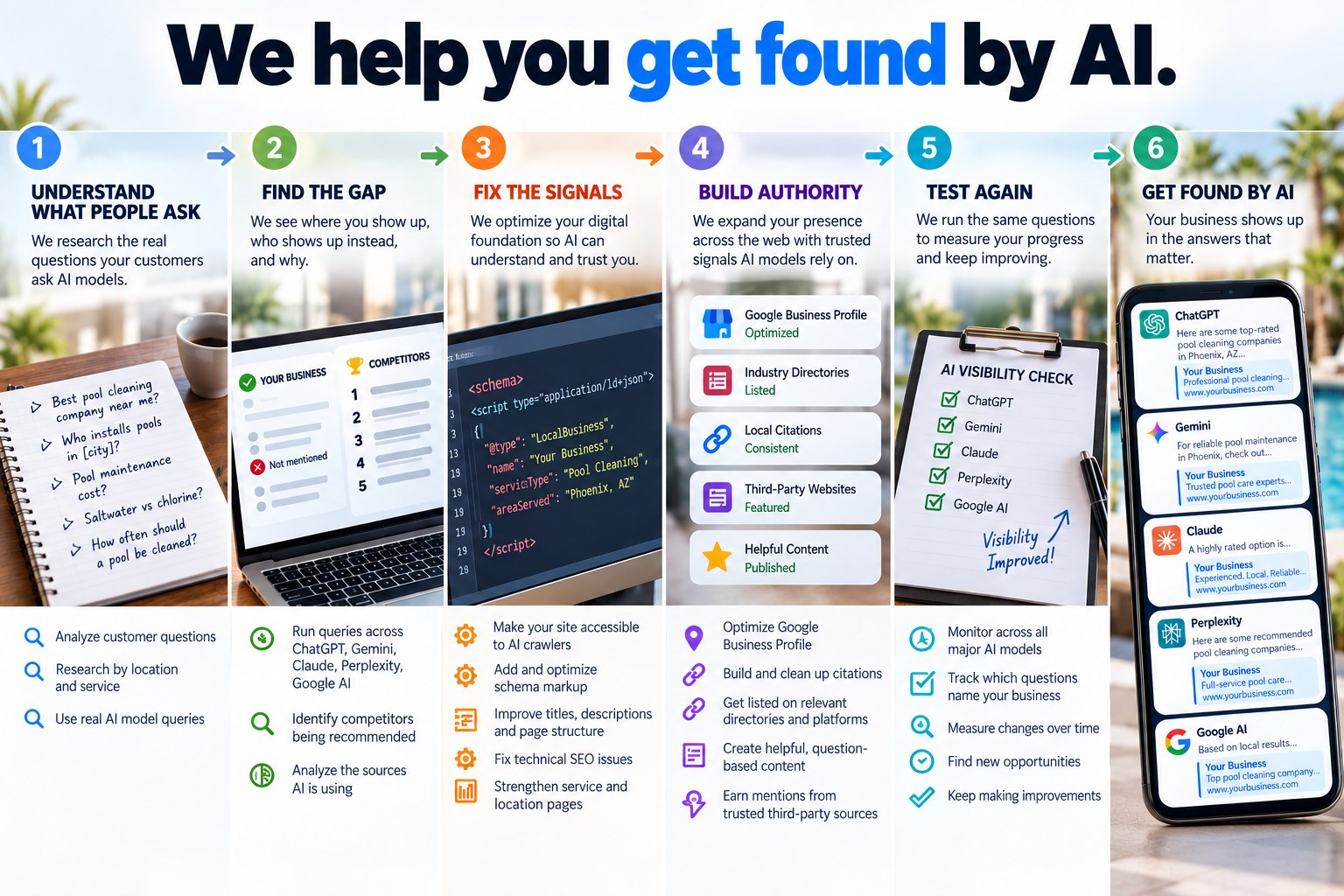
Law firms get named in AI answers by publishing practice pages that answer the client's question first, keeping attorney, directory, and review profiles consistent, letting the AI search crawlers in, and checking every claim against the state's advertising rules. The bottom line: clients are already asking ChatGPT which lawyer to hire, the answer usually names a handful of firms, and the firms named are the ones with clear pages and corroborating profiles. This guide applies our main explainer on answer engine optimization to law firms.
Why law firms should care now
iLawyerMarketing's August 2026 survey of 1,110 US consumers found 41.9 percent said they would use ChatGPT to research which lawyer to hire, up from 28.1 percent in 2025, 21 percent in 2024, and 9 percent in 2023. Half (50.1 percent) would use at least one AI answer engine, and 9.5 percent would research a firm entirely through AI. Google is still the most used source at 71.9 percent, down from 86.7 percent a year earlier. iLawyerMarketing sells legal marketing and the figures are what people say they would do, not what they did, so treat them as a direction. Clio's 2025 Legal Trends Report found that 28 percent of consumers who asked an AI a legal question were directed to contact a lawyer, and that many asked the AI to name the best lawyer.
What AI cites for lawyer questions
A Martindale Avvo and FindLaw press release reports that the four legal platforms most often cited in ChatGPT responses are Super Lawyers, Avvo, Martindale Hubbell, and FindLaw. That is a vendor's finding about its own category, so verify it for your market, but it matches how answer engines work: they look for sources that agree with your own site. A firm with a clear site and no directory profiles is easier to leave out than a firm that appears consistently in several places.
Seven steps for a law firm
- Lead each practice page with the answer. Write the first 40 to 60 words to answer the question a client types, such as what a first consultation covers, how fees work, and how long a case usually takes. Put the jurisdiction in the first sentence.
- Answer fee and timeline questions plainly. A page that says how fees are structured and what affects the timeline gives an engine something to quote. Do not state outcomes or averages you cannot support.
- Build attorney profiles. Name, bar admissions, practice areas, years in practice, and publications on a page of their own, with the same facts on the state bar, Avvo, Martindale Hubbell, Super Lawyers, and FindLaw profiles where you are listed.
- Use accurate schema. The schema.org types
LegalServiceandAttorneyexist for this, and Google says structured data must match the visible text and that no special schema is needed for its AI features. - Keep reviews and replies compliant. ABA Formal Opinion 496 addresses how a lawyer may respond to online reviews without revealing confidential information, and our guide on review replies and privacy rules shows the same trap in another profession.
- Let the search crawlers in. OpenAI says sites that opt out of
OAI-SearchBotare not shown in ChatGPT search answers, and Anthropic says blockingClaude-SearchBotmay reduce visibility in Claude search. Check robots.txt and your firewall, and keep the content in the page HTML, because the major AI crawlers do not run JavaScript, according to Vercel. - Review every claim against your state's rules. ABA Model Rule 7.1 bars false or misleading communications about a lawyer or the lawyer's services, and state rules differ. Words like best, top, and guaranteed need care, because an AI answer can repeat them back to a client under your name.
What not to do
- Do not publish client details. Confidentiality rules apply to testimonials and case stories as much as to review replies.
- Do not stuff keywords. In the GEO paper's benchmark, keyword stuffing performed about 10 percent worse than the baseline, while citations, quotations, and statistics raised visibility by up to about 40 percent.
- Do not buy reviews or directory placement as a shortcut. Many states and platforms restrict it.
How to check your results
Pick 20 to 30 questions your customers ask, run each one three times on ChatGPT, Gemini, and Perplexity, and record how often your business is named. SparkToro and Gumshoe found less than a 1 in 100 chance that two responses returned the same brand list, so repeated runs matter. Our guide on how to measure answer engine optimization has the method, and our answer engine optimization checklist covers 30 checks in five groups. For a first look, run our free answer engine optimization check.
Questions people ask
Do clients really use ChatGPT to find a lawyer?
iLawyerMarketing's August 2026 survey found 41.9 percent of consumers said they would use ChatGPT to research which lawyer to hire, and 50.1 percent would use at least one AI answer engine. It is a stated intention from a legal marketing vendor, so treat it as a direction.
Which directories matter for AI answers?
A Martindale Avvo and FindLaw press release reports Super Lawyers, Avvo, Martindale Hubbell, and FindLaw as the most cited legal platforms in ChatGPT responses. Check which ones your market uses.
Do advertising rules apply to AI answers?
The rules apply to what you publish. ABA Model Rule 7.1 bars false or misleading communications, and AI answers can repeat your claims, so review them against your state's rules.
Is answer engine optimization different for lawyers?
The steps are the same as for any business, with extra care about confidentiality, advertising rules, and directory profiles.
Sources
- iLawyerMarketing: What online sources do people use to research and find attorneys in 2026
- Clio: 2025 Legal Trends Report
- Martindale Avvo and FindLaw: AI is reshaping how clients find attorneys (press release)
- schema.org: LegalService
- schema.org: Attorney
- Google Search Central: AI features and your website
- OpenAI: Overview of OpenAI crawlers
- Aggarwal et al.: GEO: Generative Engine Optimization (arXiv 2311.09735, KDD 2024)
- SparkToro and Gumshoe: AI recommendation consistency