
Is your business even visible to AI?
Every day, high intent buyers ask AI for direct recommendations. If you are waiting to be found the old way, your competitors are getting the traffic.
Check your website in seconds
FREE!We read your site the way ChatGPT and Google AI do and score what they can and cannot understand. About ten seconds, no signup.
We read your site the way an AI crawler does and report what it can and cannot see. No signup, no card.
Six checks, about ten seconds.
AI sees your website very differently than your customers do.
Your customers see a polished, beautiful site. AI crawlers see something completely different. Drag the handle below to see both views of the same page.
Authentic Italian cooking, made by family.
Three generations of recipes from Calabria. Wood fired pizza, fresh pasta made every morning, and a wine list that knows what it's doing.
Tonight's Specials



Visit Us
This is the problem AI visibility work solves. The site looks great to people because their browser runs JavaScript and builds the page. The crawlers behind ChatGPT, Claude, and Perplexity do not run JavaScript. Vercel's analysis of AI crawler traffic found that none of the major ones render it. They download the raw HTML, find empty containers, and move on. Google's crawler does run JavaScript, which is how a site can look fine in Google and still be empty to the others. This restaurant would be invisible to them however impressive the site looks. Source: Vercel, The rise of the AI crawler
Online search is changing as you read this line.
Buyers aren't just dropping keywords into a search box anymore. They ask ChatGPT, Gemini, Perplexity and Claude a real question and expect a real answer:
Even Google is shifting. AI Overviews and AI Mode now answer questions directly inside Google Search, often before anyone reaches the traditional results.
Short search terms are over. People now ask AI complex and nuanced questions. AI looks for the best fit to match their specific needs.
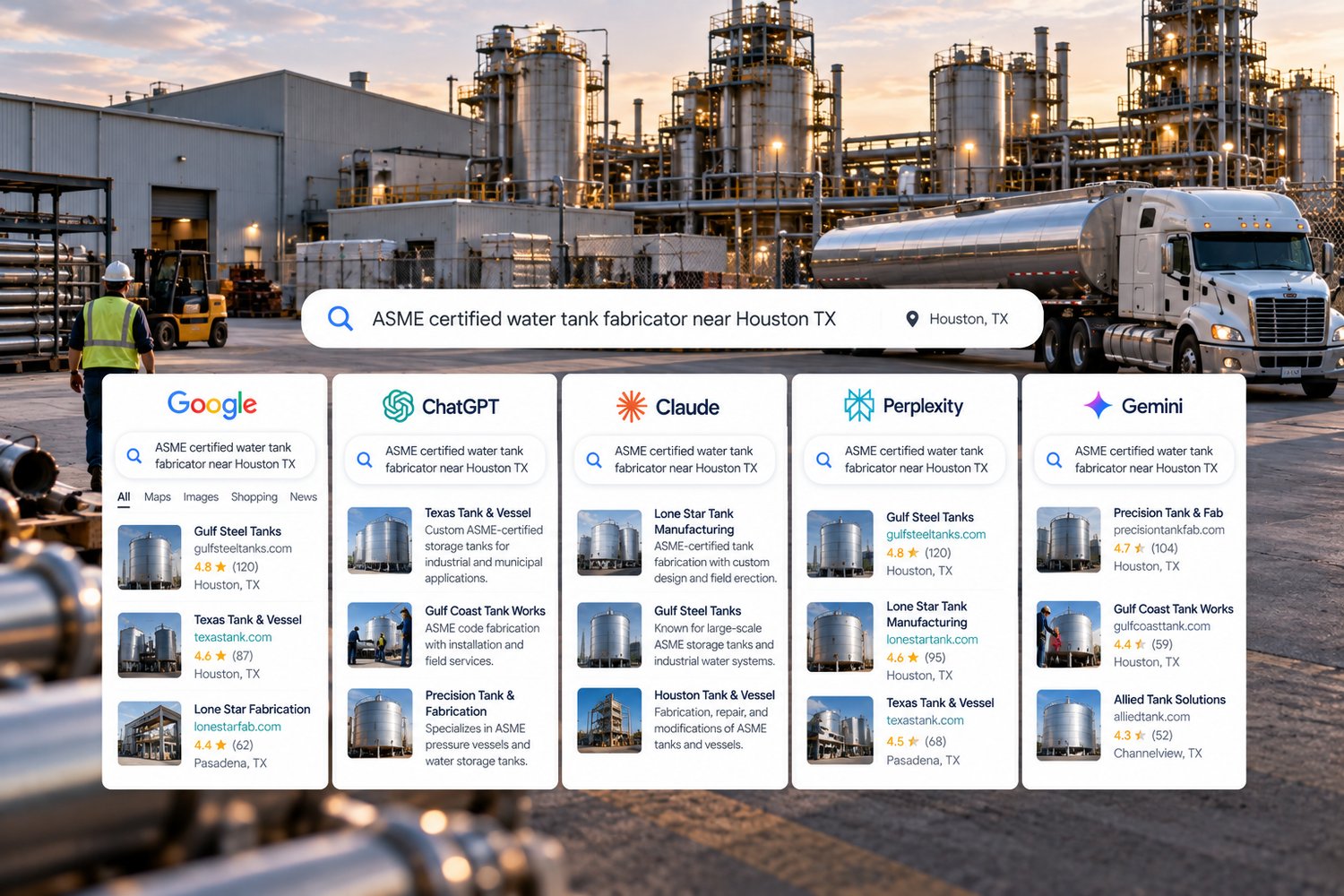
Ask five AI engines about a specific need. Do you think the answers will be the same?
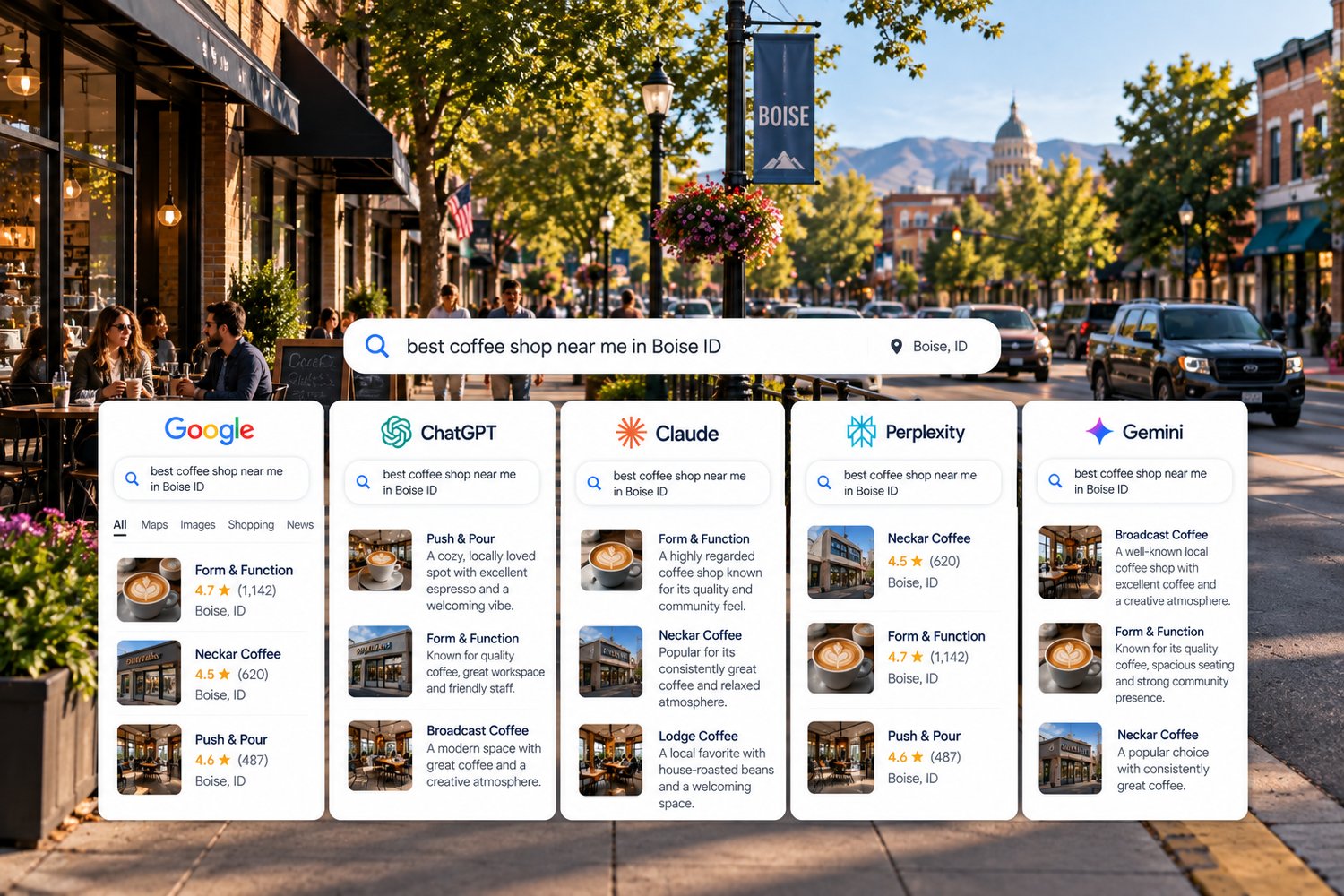
AI doesn't find businesses the way traditional search does.
AI models don't index like Google. Unless you are Nike or Amazon, they search live.
And they have a special diet.
Getting your business named and cited inside those AI answers has a name. It is called Generative Engine Optimization (GEO), also known as Answer Engine Optimization (AEO) or AI SEO. It is the work of making your site readable, trusted and quotable by AI models.
If your business isn't built to be found by AI, you risk being invisible to customers asking for exactly what you sell!
That background video on your site? It's great to persuade people, but AI doesn't spend tokens to figure it out.
That product catalog in your shop, is it even readable by all AI models?
You may be losing traffic at this very moment, but there's a huge opportunity here for you.
If you adjust to the new reality before your competition, you'll get ahead of the curve before everyone else does.
This shift is RARE. It is huge and it is happening right now.
You want your business to be part of it.
How we get you found.
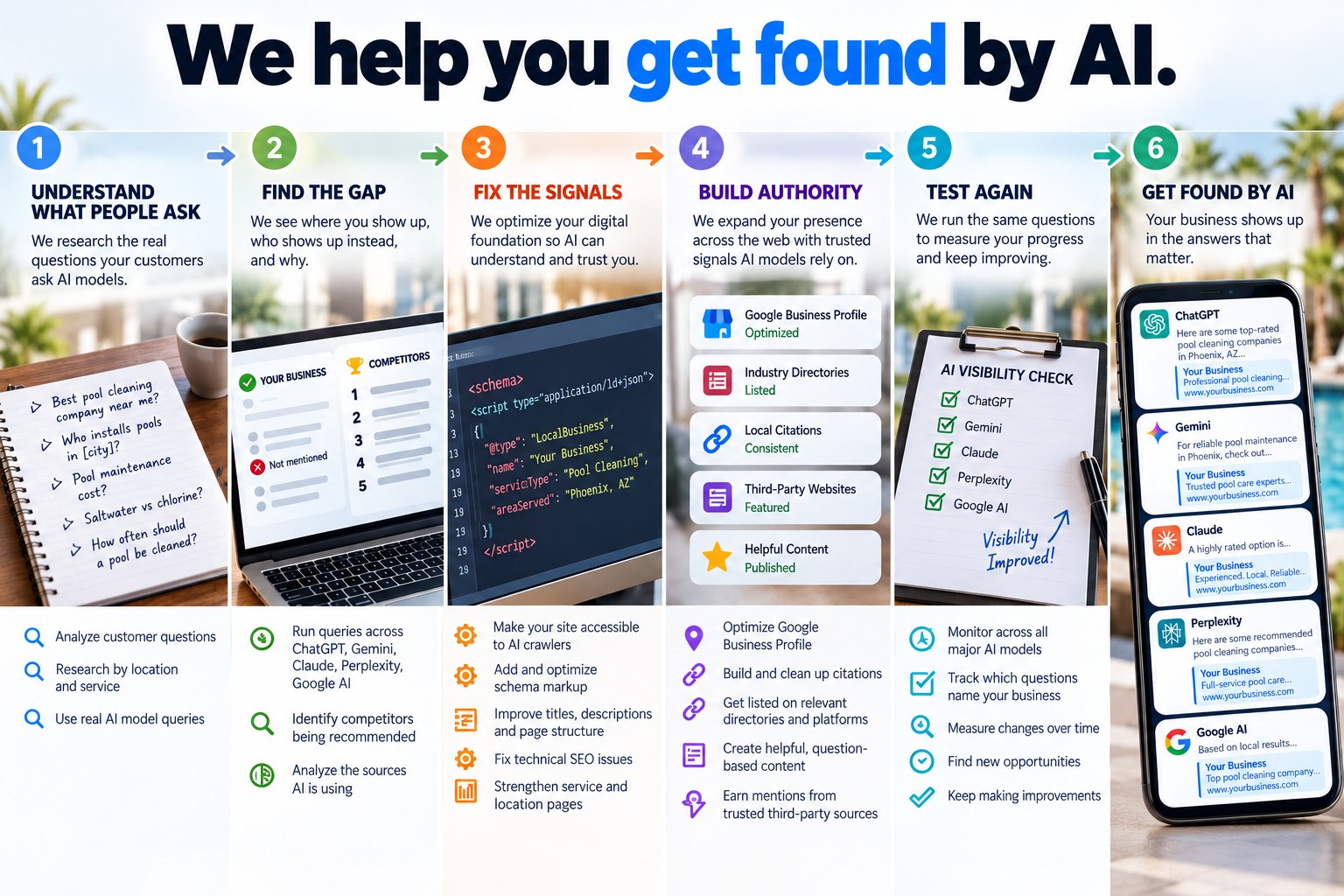

Start today, before your competition does!
- 10 customer questions monitored every monthAcross ChatGPT, Gemini, Perplexity, Claude and Google AI.
- Technical AI visibility setupCrawler access tested, structured business data installed, titles and descriptions improved, and search tracking connected.
- Monthly competitive visibility reportSee exactly which questions named you, which didn't, and which competitors appeared.
- 2 new pages or content improvements every monthBuilt around actual visibility gaps found in your monitoring.
- Everything in AI Visibility, plus:
- 25 customer questions monitored every month
- Business listings built on 30 directoriesSubmitted manually, not synced. The listings stay yours if you ever leave us.
- Google Business Profile optimization
- FAQ and question based content with structured data
- 5 new pages or major content improvements every month
- Monthly listing accuracy checkWe recheck the directories we built and correct your name, address, phone and hours wherever they have drifted.
- Everything in AI Growth, plus:
- 50 customer questions monitored every month
- Deeper competitor and source analysisWe don't only track who beats you. We examine the sources and signals associated with the businesses AI keeps recommending.
- Site structure and service page improvementsWe improve the parts of the site that affect both AI understanding and what visitors do after they arrive.
- Strategic content productionContent is based on opportunity, not an arbitrary page quota. We build and improve the pages that have a reason to exist.
- Duplicate listing removal and data aggregator submissionConflicting listings removed and your business data pushed to the aggregators that feed directories, maps and apps.
- Reddit and industry forum presencePosted by a person who knows the rules of each community. No automation and no spam, because both get removed and both hurt you.
- Monthly strategy reviewWe review what changed, where competitors moved and what we work on next.
- Custom monitoring and contentScaled to all your locations and markets.
- Technical work and CRM integrationConnected to your broader marketing and sales system.
- Lead tracking and automationSo AI visibility turns into booked business.
Clients report returns of up to 1,500%
Client reported. Results vary.And this isn't happening outside Google either. Google has built AI directly into Search. Google has put AI Overviews at more than 2.5 billion users each month. On its July 2026 earnings call, Google said AI Mode has passed one billion monthly users and the Gemini app has 950 million monthly users.
People still use traditional search, and SEO still matters.
But there is now another layer between the customer and the businesses they choose. A customer can ask a detailed question, explain exactly what they need, and receive a direct answer.
The businesses included in that answer have an opportunity. The businesses that aren't included don't.
The questions are getting more specific
Traditional search was built around keywords.
Trucking company in Nashville
Personal injury lawyer Tampa.
Commercial generator company Virginia.
"I have a burst pipe at 11 PM in Houston. Who can come tonight?"
"Which personal injury law firms in Tampa handle motorcycle accidents and offer free consultations?"
"Which companies supply, install and maintain backup generators for hospitals and data centers in Virginia?"
AI lets the customer explain the whole problem. Those are different searches, and they create a different visibility challenge.
Your business doesn't just need to exist online. The information about your business needs to clearly communicate what you do, where you do it, who you serve and the specific problems you solve.
CRM for real estate teams in Austin gets five different providers ranked first across the engines.
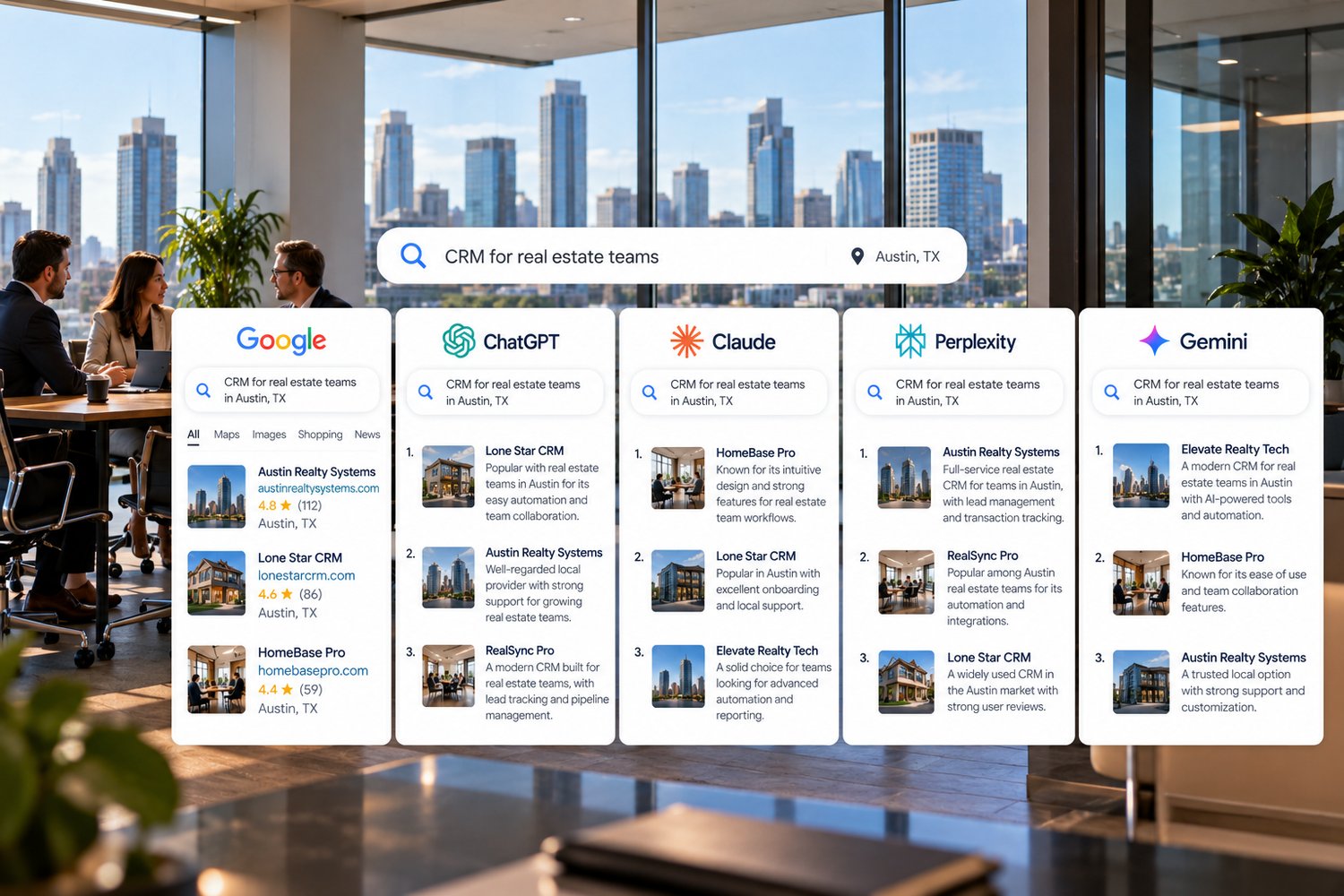
What are we actually working on?
AI visibility doesn't come from changing one line of code.
We work across the different parts of your online presence that help search and AI systems understand your business.
Your website
We make sure your site clearly communicates your services, locations, expertise and business information.
Technical accessibility
We check whether relevant AI search crawlers can access the site and address technical issues that may prevent important information from being discovered.
Structured data
We add and improve structured information that helps machines understand the business behind the website.
Citations
We strengthen your business information across relevant directories, review platforms and other sources.
Content
We create content around real questions your customers ask, including the specific questions where your business is currently missing.
Monitoring
We keep asking those questions. Then we compare what comes back month after month.
Why can I rank on Google and still be missing from AI?
Because they are not the same experience.
A traditional Google search can give someone pages of results. An AI answer may summarize the subject, cite sources and name only a handful of businesses.
Independent analyses published through 2026 have found that the sites cited inside AI answers frequently differ from the sites ranking at the top of the organic results for the same query, and that a large share of AI answer sessions end without a click to any website at all.
Being visible in one environment does not automatically mean you will be visible in another. That is why we measure the AI answers themselves instead of assuming that a Google ranking tells us what ChatGPT, Gemini, Perplexity or Claude will say.
Does this replace SEO?
No. SEO still matters. Google still matters. Your website still matters.
AI visibility adds another layer. The goal isn't to abandon traditional search. It's to make sure your business is prepared for the way customers are increasingly discovering and evaluating companies through AI as well.
Can you guarantee that ChatGPT will recommend my business?
No. And you should be suspicious of anyone who says they can.
No agency controls what ChatGPT, Gemini, Perplexity, Claude or Google's AI systems decide to recommend.
What we can control is the work. We can make sure your site is accessible. We can improve how clearly your business is described. We can strengthen your citations. We can create content around the questions your customers are actually asking. And we can measure what happens afterward.
How fast can my AI visibility change?
There is no universal timeline.
Some technical improvements can be made immediately. Changes in what AI systems discover, cite or recommend can take longer. It also depends on the market, the competition, the question being asked and the AI engine answering it.
That is exactly why we monitor the same questions over time. We're not showing you one screenshot and calling the job finished. We're watching what happens month after month.
What questions do you monitor?
Questions that represent real potential customers.
Some are broad: "Best commercial HVAC company in Phoenix." Others are specific: "Who repairs industrial chillers for manufacturing plants in Phoenix?" Some are highly specific: "Which HVAC contractors in Phoenix service Trane industrial chillers and offer emergency support?"
The questions depend on your business, your customers, your services and the markets you serve.
What if I don't know which questions to track?
That's fine. We work with you to determine which questions make sense based on your services, customers and market.
The goal isn't to track random prompts. The goal is to track the questions that could realistically lead someone to your business.
Do you need access to my website?
Yes. If we're going to make technical changes, improve pages and publish new content, we need access to the website.
You can revoke that access at any time. The content and improvements already made to your website remain yours.
Is there a contract?
No long term contract. You pay monthly and can cancel.
Why start now?
Because customer behavior is changing while businesses are still figuring out what to do about it.
AI search is already being used at enormous scale. Google is putting AI directly inside the search experience. Customers can ask increasingly detailed questions and receive increasingly direct answers.
You don't need to predict where this ends.
You need to know whether your business is showing up now.
Ask the question yourself. Look at the businesses AI recommends.
If your competitors are there and you aren't, you already know why you're here.
Start building your AI visibility
Ongoing work based on what the AI engines actually return.