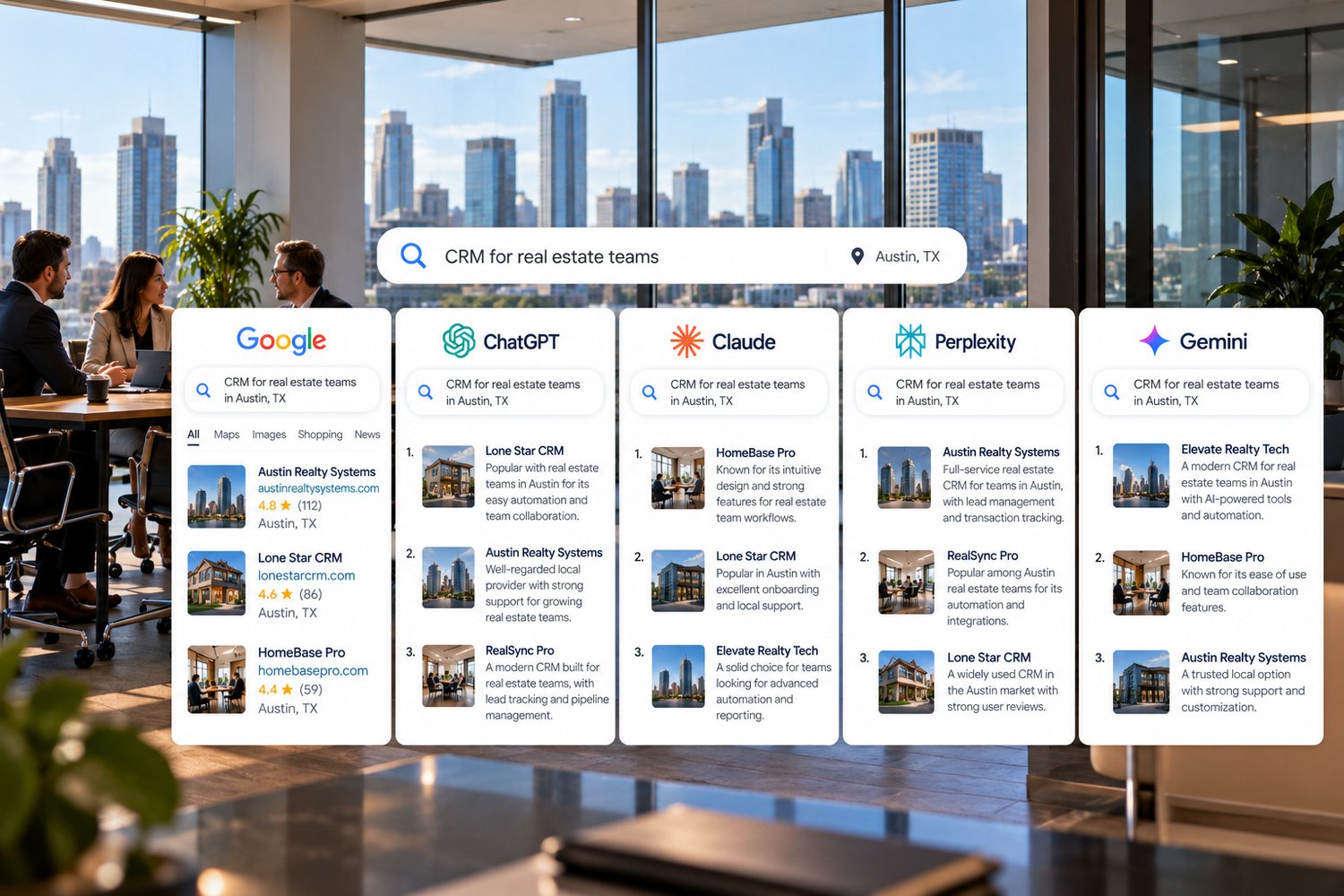
To get cited by ChatGPT, let OpenAI's search crawler read your site, publish pages where the direct answer comes first and is backed by numbers, sources, and dates, and build mentions of your business on other sites. Nothing guarantees a citation, because no one controls what an assistant says, but a crawler that cannot reach you rules you out. The bottom line: access first, then answer quality, then outside proof. This guide supports our main explainer on answer engine optimization.
How ChatGPT finds sources
OpenAI documents separate crawlers. OAI-SearchBot is used to surface websites in ChatGPT's search features, and OpenAI says sites that opt out of it will not be shown in ChatGPT search answers, though they can still appear as navigational links. OpenAI recommends allowing OAI-SearchBot in robots.txt and allowing requests from its published IP ranges. GPTBot is a separate crawler tied to training, and ChatGPT-User is used for certain user actions. OpenAI says ChatGPT-User is not used to decide whether content appears in search, and that because those actions are user initiated, robots.txt rules may not apply to it.
The eight steps
- Allow
OAI-SearchBot. Check robots.txt and any firewall or CDN rules. A site can block GPTBot and stay eligible for ChatGPT search as long asOAI-SearchBotis allowed. - Put the answer in the first lines. AirOps found 44 percent of ChatGPT citations came from the first 30 percent of a page. State the answer, then explain.
- Match real questions. Write headings the way customers ask: how much does it cost, how long does it take, which is better.
- Add specifics. In the GEO paper's benchmark, adding citations, quotations, and statistics raised visibility in generated answers by up to about 40 percent. Use real figures with sources and dates.
- Keep pages fresh. Ahrefs found AI cited content averaged 2.9 years old, against 3.9 years for organic results. Show the updated date and mean it.
- Be consistent off site. Reviews, directories, and community and reference pages corroborate your claims.
- Make claims you can be quoted on. Pricing ranges, service areas, comparisons, and definitions are easier to quote than slogans.
- Measure with repeated runs. Single answers vary. Run each question many times and track how often you are named.
A robots.txt example
This allows OpenAI's search crawler and leaves the training decision to you. Adjust it to your own policy.
User-agent: OAI-SearchBot
Allow: /

User-agent: GPTBot
Disallow: /
The second rule is optional. It blocks training use without affecting search eligibility, according to OpenAI's separation of the two crawlers.
What does not work
- Stuffing keywords. It performed about 10 percent worse than the unmodified baseline in the GEO benchmark.
- Adding markup as a trick. Ahrefs found no citation lift from adding JSON LD markup to pages already cited more than 100 times.
- Expecting a stable ranking. SparkToro and Gumshoe found less than a 1 in 100 chance that two responses returned the same brand list.
If ChatGPT gets facts about you wrong
When an answer states the wrong hours, prices, or services, look for the source it used. The cause is usually an outdated page on your own site, an old directory listing, or a review that mentions something that has changed. Fix the page or listing, update the date, and check again in a few weeks. There is no form that corrects a model's memory, and answers that use live search pull from current pages, which is why access and freshness come first.
How this differs from Google
Google AI Overviews draw on Google's own index, so ranking and indexing in Google Search come first. ChatGPT search uses OpenAI's crawler and its own retrieval, so a page can be strong in Google and absent from ChatGPT if OAI-SearchBot is blocked. That is why the first check in our answer engine optimization checklist is crawler access for each engine, not just Google. For the Google side, see how to show up in Google AI Overviews.
How to see whether ChatGPT cites you
Ask ChatGPT the questions your customers ask, several times, with search on, and record whether your business is named and whether a link to your site appears. Check your analytics for visits from chatgpt.com. Our guides on how to check if your business appears in ChatGPT, how ChatGPT decides which sources to cite, and how to measure answer engine optimization cover the method. For a first look at how AI describes your business, run our free answer engine optimization check.
Questions people ask
How does ChatGPT choose which websites to cite?
OpenAI says OAI-SearchBot surfaces sites in ChatGPT search. Beyond access, studies point to answer first content, specific facts, freshness, and outside corroboration, but no one publishes a complete formula.
Should I allow GPTBot?
GPTBot is a training crawler and is a separate decision. Blocking it does not stop OAI-SearchBot from surfacing your site in ChatGPT search.
Does ChatGPT-User follow robots.txt?
OpenAI says that because ChatGPT-User actions are initiated by a person, robots.txt rules may not apply, and it is not used to decide search appearance.
Can I guarantee a ChatGPT citation?
No. Answers vary between runs, and OpenAI does not guarantee inclusion.
Sources
- OpenAI: Overview of OpenAI crawlers
- Quattr: AirOps position finding and Ahrefs schema test
- Aggarwal et al.: GEO: Generative Engine Optimization (arXiv 2311.09735)
- Ahrefs: do AI assistants prefer to cite fresh content
- SparkToro and Gumshoe: AI recommendation consistency
- Scalableloops: AI crawlers in robots.txt
- Cloudflare: AI crawler detection IDs and user agents