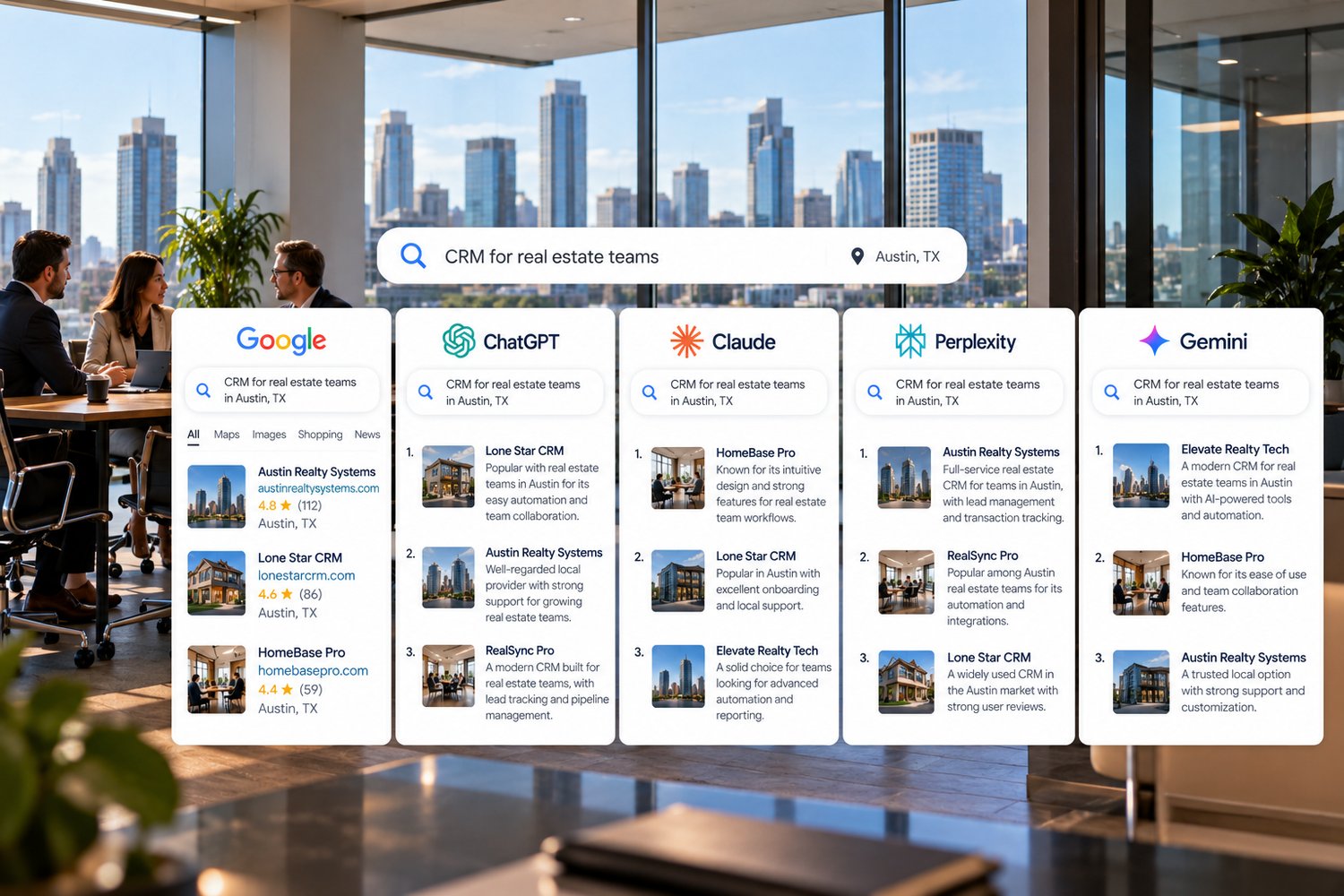
Real estate agents get named in AI answers by publishing agent and market pages that answer the buyer's or seller's question first, keeping the same facts across their site, brokerage page, and listing profiles, building reviews, and checking market copy for Fair Housing problems. The bottom line: most buyers still hire an agent and most interview only one, so a name that AI puts on a short list matters, and the data on how often that happens is mixed. This guide applies our main explainer on answer engine optimization to agents and teams.
What the data shows, and where it disagrees
NAR's 2025 Profile of Home Buyers and Sellers found 88 percent of buyers purchased through an agent or broker, and that most buyers interview only one agent: 67 percent of first time buyers and 76 percent of repeat buyers. A Zillow 2026 Consumer Housing Trends Report, as reported in trade coverage, found roughly half of recent buyers used AI during their purchase, with 74 percent of those asking for an explanation of the process and 70 percent asking for home recommendations, while 85 percent of buyers still used an agent. NAR's own news service reported in June 2026 on an analysis by an AI search firm, FlyDragon, which found that fewer than 10 percent of agents appear in AI generated responses to location based questions about real estate professionals. That is a vendor's finding, so treat it as a direction.
Other vendor surveys claim far higher shares of buyers use AI to find an agent, from 22 percent to 79 percent depending on the source and the wording. We could not verify those, and they are not independent research, so we do not rely on them. The safe reading is that AI is becoming an early step in the search, that buyers still hire agents, and that the agent named early has an advantage when buyers interview only one.
Seven steps for an agent or team
- Write an agent page with facts. Name, license, brokerage, areas served, years in business, transactions in the last year if you can support the number, designations, and how to reach you. Keep it identical to your brokerage and portal profiles.
- Answer the market questions first. What it costs to sell here, how long homes take to sell, how offers work, and what the steps are, in the first 40 to 60 words, with a source and a date for every figure.
- Write neighborhood pages from data. Use public sources for prices, schools, and commute times, and cite them. Describe amenities and property types, not who lives there.
- Use accurate schema. The schema.org type
RealEstateAgentexists for this, and Google says markup must match the visible text and that no special schema is needed for its AI features. - Build reviews on the platforms buyers use. Google, Zillow, and Realtor.com profiles should agree on your name, brokerage, and service area, and every client should be asked for a review the same way.
- Let the search crawlers in. OpenAI says sites that opt out of
OAI-SearchBotare not shown in ChatGPT search answers, and Anthropic says blockingClaude-SearchBotmay reduce visibility in Claude search. Check robots.txt and your firewall, and keep the content in the page HTML, because the major AI crawlers do not run JavaScript, according to Vercel. - Check market copy for Fair Housing problems. The Fair Housing Act bars discrimination based on race, color, national origin, religion, sex, familial status, and disability, and steering does not require bad intent. Phrases like great for families or a safe area can signal a preference, so point readers to official sources instead.
How to check your results
Pick 20 to 30 questions your customers ask, run each one three times on ChatGPT, Gemini, and Perplexity, and record how often your business is named. SparkToro and Gumshoe found less than a 1 in 100 chance that two responses returned the same brand list, so repeated runs matter. Our guide on how to measure answer engine optimization has the method, and our answer engine optimization checklist covers 30 checks in five groups. For a first look, run our free answer engine optimization check.
Once the pages are in place, our guides on responding to online leads within minutes and the missed call text for sign callers cover what to do when the lead arrives.
Questions people ask
Do buyers use ChatGPT to find a real estate agent?
Zillow's 2026 report, as covered in trade news, found roughly half of recent buyers used AI during their purchase, and 85 percent still used an agent. Vendor surveys claiming much higher shares for agent discovery are unverified.
How many agents does a buyer talk to?
NAR's 2025 Profile found 67 percent of first time buyers and 76 percent of repeat buyers interviewed only one agent.
What should an agent page say?
Name, license, brokerage, areas, years in business, and verifiable results, matching the brokerage and portal profiles.
Do Fair Housing rules apply to AI answers?
They apply to what you publish. Avoid describing areas by who lives there, and use official sources for schools and safety.
Sources
- NAR via BAM: 88 percent of home buyers still rely on agents, NAR 2025 report
- NAR via BAM: How home buyers and sellers find their agents in 2025
- NAR REALTOR News: AI becomes early step in homebuying journey (June 30, 2026)
- PlotDaily: Zillow, about half of homebuyers used AI, while 85 percent used an agent
- HUD: Fair Housing Act overview
- schema.org: RealEstateAgent
- BrightLocal: Local Consumer Review Survey 2026
- Google Search Central: AI features and your website
- OpenAI: Overview of OpenAI crawlers
- SparkToro and Gumshoe: AI recommendation consistency