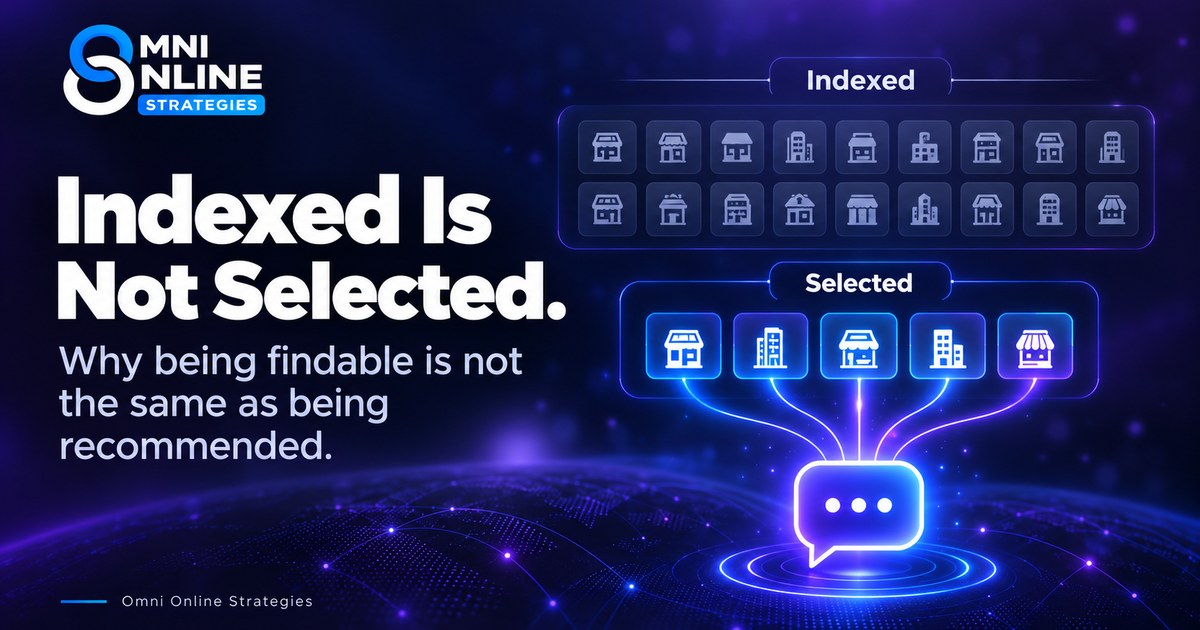
A lot of marketing around AI visibility is misleading on one point: being indexed is necessary, and it is not the same as being selected by AI. Imagine ChatGPT is asked who the best personal injury lawyers in Tampa are. The retrieval system may have tens of thousands of indexed pages about Tampa lawyers. The model cannot use all of them, so retrieval has to pick a small body of evidence for that specific question. The bottom line: the pipeline runs indexed, retrieved, understood, considered relevant, corroborated, and mentioned, the published data shows large drop offs at the later stages, and traditional SEO work mostly addresses only the first one.
See also: answer engine optimization, explained step by step.
Why an index cannot hand everything to the model
Two limits stand between an index and an answer. The first is size: a model can only consider a limited amount of text at once, so retrieval passes it a short list. The second is attention. A 2024 study in the Transactions of the Association for Computational Linguistics, "Lost in the Middle," found that model performance is often highest when the relevant information sits at the beginning or end of the input and drops significantly when it sits in the middle of a long context, even for models designed for long contexts. Being on the short list is not enough. Where your information sits, and how clearly it answers the question, still decides whether it gets used.
The pipeline, stage by stage
| Stage | What decides it | What the evidence says |
|---|---|---|
| Indexed | Whether crawlers can reach and read the page: robots.txt rules, content present in the HTML instead of built by JavaScript. | This is the one stage traditional SEO fully covers, and it is necessary before anything else can happen. |
| Retrieved | Whether the page matches the searches the system generates from the question, including related sub queries. | Google's AI features use query fan out. Ahrefs suggests brands may now be judged less on one ranking position and more on whether content covers a topic deeply enough to support related queries. |
| Understood | Whether the answer is clear and extractable: a title that matches the question, and the answer placed early. | AirOps, as summarized by Quattr, found title to query alignment matters and that 44 percent of citations draw from the first 30 percent of a page. Treat that as directional. |
| Considered relevant | Whether the page fits this specific question, including location and situation. | The more specific the question, the more a page must state its service area, services, and pricing plainly. |
| Corroborated | Whether other sources say the same thing about you. | BlueGrid Media's weighting puts 42 of 100 points on what others say about you. Ahrefs found list style pages are cited heavily in AI Overviews, and Quattr's reading is that brands get into those lists through recognized authority and third party coverage. |
| Mentioned | Whether the model names you this time. | SparkToro and Gumshoe found less than a 1 in 100 chance that two responses returned the same brand list, so appearing is a matter of frequency across many runs. |
How much does ranking still matter
It matters less than it did, and the honest answer depends on which product and when. Ahrefs found 76.1 percent of the pages cited in Google AI Overviews ranked in the top 10 for the same query in July 2025, and 37.9 percent in March 2026, in a study of 863,000 keywords and 4 million AI Overview URLs. In that later study 31.2 percent of cited pages ranked between positions 11 and 100, and 31.0 percent ranked outside the top 100 entirely. BrightEdge, using its own method, reported about 17 percent in February 2026. Ahrefs itself notes that part of the drop reflects improved citation detection, and Google made Gemini 3 the default model behind AI Overviews on January 27, 2026, so the two datasets are not directly comparable.
Other surfaces differ. Ahrefs tested 15,000 long tail queries on four AI assistants in August 2025 and found on average only 12 percent of the links assistants cited ranked in Google's top 10, with 8 percent for ChatGPT's in text citations and 28.6 percent for Perplexity, according to a summary by ELMO. ELMO's review of every published study found overlap estimates ranging from 12 percent to 93 percent. The spread is the finding: ranking is neither necessary nor sufficient for a citation, and an overlap number is specific to the surface and the date it was measured.
Two equally indexed companies, two different outcomes
Suppose two HVAC companies are equally well indexed. Company A's whole web footprint says: welcome to ABC Heating, quality service you can trust. Company B has clear pages about emergency AC repair in Orlando, service area information, pricing explanations, reviews, third party directory profiles, consistent business information across those profiles, FAQs answering specific homeowner questions, and other sites independently discussing the company.
Ask an AI who does emergency AC repair near Winter Park and is available on weekends. There is far more machine retrievable evidence connecting Company B to those exact concepts. Company A is indexed. Company B is retrievable, understandable, and corroborated, and only one of them tends to get mentioned.
There is no single index to optimize for
AI systems do not necessarily rely on one Google style index. Depending on the product and the query, they can use their own indexes, third party search providers, direct browsing, structured data sources, maps and business data, and knowledge learned during training, sometimes several at once. The evidence fits that picture. Seer Interactive found 87 percent of 500 SearchGPT citations matched Bing's top results in early 2025, while Ahrefs later found assistants' cited links rarely matched Google or Bing rankings, and Ahrefs found Google's own AI Mode and AI Overviews cite different sources 87 percent of the time. Optimizing for one index and assuming that covers AI visibility misses most of how these systems gather evidence.
What AI visibility actually is
AI visibility is not making ChatGPT learn that a company exists. That framing describes something that mostly is not happening and cannot be directly engineered. The accurate version is that it increases the probability that AI systems can find, understand, substantiate, and cite or recommend a business when customers ask relevant questions. That is also what a regular AI visibility check should test: not whether a company exists inside a model, but whether it gets surfaced for the commercially relevant questions real customers ask, measured as the share of many runs that name it.
What to do at each stage
- Indexed: allow AI search bots in robots.txt, and confirm your text is in the raw HTML, not only rendered by JavaScript.
- Retrieved: cover the related questions around each service, not only the head term, so more of the searches the system generates can find you.
- Understood: title each page the way a customer phrases the question, and state the direct answer at the top of the page and of each section.
- Relevant: state service areas, services, hours, and pricing plainly, since specific questions need specific facts.
- Corroborated: keep business details consistent across directories and profiles, earn reviews on more than one platform, and build presence on the sites AI systems cite in your category.
- Mentioned: measure. Run 10 real customer questions five times each on ChatGPT, Gemini, and Perplexity, log how often you are named, and repeat after each round of changes.
Questions people ask
Is being indexed by Google the same as being visible to AI?
No. Indexing is necessary but not sufficient. An AI system still has to retrieve a page, understand it, judge it relevant to the specific question, and find corroboration before it names a business.
Do pages that rank in Google's top 10 get cited by AI?
Sometimes. Ahrefs found 37.9 percent of pages cited in Google AI Overviews ranked in the top 10 in March 2026, down from 76.1 percent in July 2025, and other studies found lower overlap for chatbots. Ranking is neither necessary nor sufficient.
Why are most retrieved pages never cited?
Retrieval is only the first filter. AirOps found only about 15 percent of pages ChatGPT retrieved appeared in the final answer, so pages also have to be clear, relevant, and corroborated to be used.
What does AI visibility actually mean?
It means increasing the probability that AI systems can find, understand, substantiate, and cite or recommend a business when customers ask relevant questions, not making a model learn that a company exists.
Sources
- Ahrefs: AI Overview citations and top 10 rankings (summarized by ALM Corp)
- DesignRush: Ahrefs study on AI Overview citations
- ELMO: do Google rankings drive AI citations, every study compared
- Quattr: what Ahrefs' AI search research really tells us (summarizing AirOps and Ahrefs)
- Liu et al., Lost in the Middle: How Language Models Use Long Contexts (TACL 2024)
- Seer Interactive: 87% of SearchGPT citations match Bing's top results
- Ahrefs: how AI assistants' cited URLs compare with Google and Bing rankings
- BlueGrid Media: AI Visibility Checker and methodology
- SparkToro and Gumshoe: AI recommendation consistency study