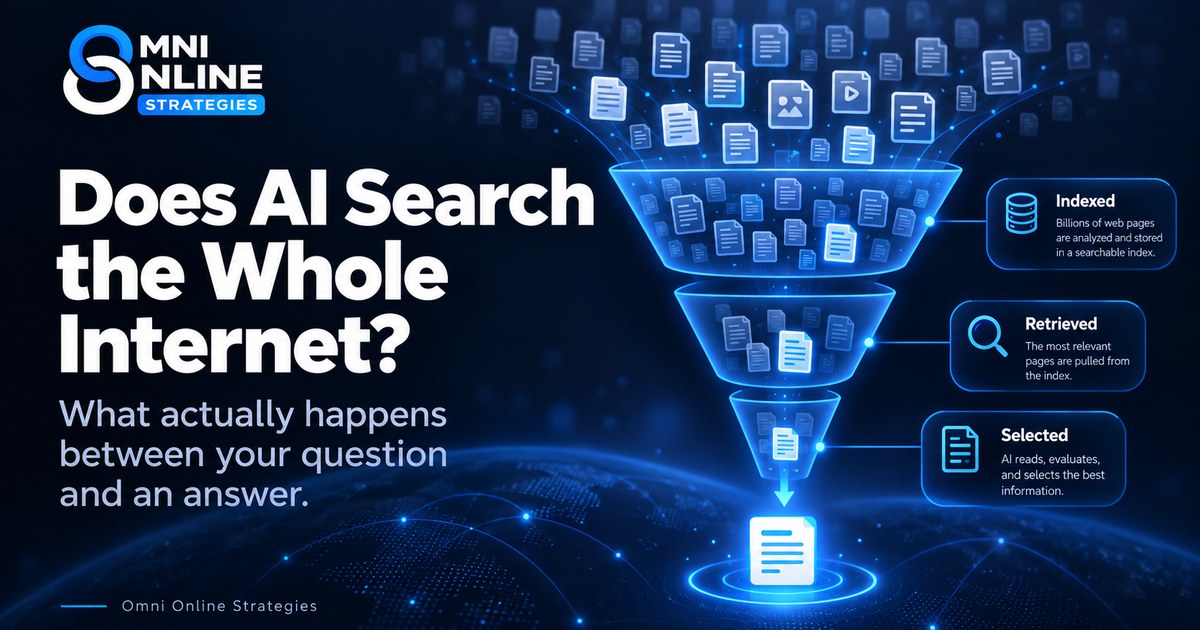
No. It does not scan the entire internet every time you ask a question. Two different things happen, and confusing them is where most bad advice about AI search comes from. Sometimes the model answers from what it learned during training and searches nothing at all. Other times it sends a few targeted searches to an index that was built long before you asked, reads a small handful of passages, and writes an answer from those. The bottom line: an AI system does not need to know your business, it needs a retrieval system to pick your pages out of an index and then choose to use them, and most pages that get retrieved are never cited.
See also: answer engine optimization, explained step by step.
Where the idea comes from
Combining a language model with a searchable index is not new with ChatGPT. The formal version is retrieval augmented generation, introduced in a 2020 paper by Patrick Lewis and colleagues at NeurIPS, where the model's own learned knowledge, its parametric memory, is combined with an external index it can look things up in, its non parametric memory. The reason is practical. A model's training data has a cutoff and cannot hold every fact, so retrieval lets it draw on information that was not baked in.
The consumer versions arrived recently. OpenAI announced SearchGPT in July 2024 and launched it as ChatGPT Search on October 31, 2024. Google made Gemini 3 the default model behind AI Overviews globally on January 27, 2026. Every one of these products follows the same basic shape: some answers come from memory, and others come from retrieval.
What the model already knows
The model was trained beforehand on a very large body of text, and that knowledge lives in its parameters. Ask why the sky is blue and it usually searches nothing. It generates the answer from training, the way a person answers from memory instead of looking it up.
How often that happens is measurable, and it has shifted. Semrush analyzed 80 million lines of clickstream data from the second half of 2024 and found ChatGPT answered about 54 percent of queries with search off and 46 percent with search on. Its later study, covering more than one billion lines of US clickstream data from October 2024 to February 2026 across a 200 million user panel, found web search triggered on only 34.5 percent of queries as of February 2026. Most responses still rely on training data. Anything that happened after the model's training cutoff can only appear in an answer if a search runs.
When it does search
When retrieval happens, the system does not pass your question along unchanged. In Semrush's 2024 data the average ChatGPT prompt was 23 words while the average search it ran was 4.2 words, so the system rewrites a long conversational question into short queries. Google's AI features do the same at larger scale through what is called query fan out, breaking one question into several related searches and, according to Ahrefs' analysis, citing pages that perform well across that whole cluster.
So for "best plumber in Bozeman Montana," the system might issue searches close to best plumber Bozeman MT, emergency plumber Bozeman, and plumbing companies Bozeman reviews, then read what comes back.
The index was built beforehand
The search infrastructure already holds billions of indexed pages. The AI is not visiting billions of sites when you press enter, in the same way Google does not read millions of pages after you press search. The expensive crawling and organizing happened earlier, and your query searches the result. AI search adds a layer on top of that foundation: the internet is crawled and indexed in advance, retrieval runs at question time, the AI reads a small selected set, and it reasons over that set to write the answer.
Which index is used matters, and the evidence is not tidy. Seer Interactive checked more than 500 SearchGPT citations in early 2025 and found 87 percent matched Bing's top results, consistent with ChatGPT search leaning on Bing. Later, Ahrefs tested 15,000 long tail queries across four AI assistants in August 2025 and reported that the links assistants cited rarely matched the top 10 on Google or Bing, and were often outside the top 100. Different samples, different dates, different answers. The safe reading is that each product retrieves differently and the pattern is still moving.
Most retrieved pages are never used
Retrieval is the first filter. AirOps analyzed more than 548,000 pages ChatGPT retrieved and found only about 15 percent showed up in the final response, according to Quattr's summary of the report. The same research points to a few signals that appear to influence which retrieved pages survive: how closely the page title matches the query, where the answer sits on the page, with 44 percent of citations drawn from the first 30 percent of a page, and freshness, with content updated in the past three months cited roughly twice as often. These come from one study and Quattr treats them as directional, not settled rules.
The model does not use everything it is handed equally
Even a page that makes it into the model's context is not read like a person reads. A study published in the Transactions of the Association for Computational Linguistics in 2024, "Lost in the Middle," tested multi document question answering and key value retrieval and found performance is often highest when the relevant information is at the beginning or end of the input, and significantly worse when it sits in the middle of a long context, even for models built for long contexts. The practical implication is that the answer belongs near the top of a page and near the top of each section, not buried in the middle of a long block.
Why two AI systems give different answers
Ask the same question on two products and the recommendations can differ completely, because their indexes, query rewriting, ranking, and reasoning all differ. Ahrefs found Google's own AI Mode and AI Overviews cite different sources 87 percent of the time for the same query. In the SparkToro and Gumshoe study of 2,961 runs across ChatGPT, Claude, and Google's AI features, there was less than a 1 in 100 chance that two responses returned the same list of brands, even for the same prompt on the same platform.
What this means if you want to be used
- Let the search bots in. If robots.txt blocks bots such as
OAI-SearchBot,Claude-SearchBot, orPerplexityBot, your pages cannot be fetched to answer a live question. - Put your content in the HTML. Text that only appears after JavaScript runs may not be there when a crawler reads the page.
- Answer first. State the direct answer at the top of the page and of each section.
- Match the question in the title. Write titles and headings the way a customer phrases the question.
- Keep dates current. Update pages that carry facts that change.
- Build presence beyond your site. A page can be retrieved and still lose to pages with more corroboration.
- Measure the share of runs that name you. Run 10 real customer questions five times each on several platforms and track the percentage, since one answer proves nothing.
Questions people ask
Does AI search the entire internet every time you ask a question?
No. Many answers come from the model's training data with no search. When a search runs, the system sends a few targeted queries to an index that was built in advance.
How often does ChatGPT actually search the web?
Semrush found web search was triggered on 34.5 percent of ChatGPT queries as of February 2026, down from 46 percent in late 2024.
What is retrieval augmented generation?
It is a method, introduced in a 2020 paper by Patrick Lewis and colleagues, that combines a language model's learned knowledge with an external index it can search at question time.
Why do different AI systems give different business recommendations for the same question?
Each system uses a different index, query rewriting, ranking, and reasoning. Ahrefs found Google's AI Mode and AI Overviews cite different sources 87 percent of the time, and SparkToro found repeated runs almost never return the same brand list.
Sources
- Lewis et al., Retrieval-Augmented Generation for Knowledge-Intensive NLP Tasks (NeurIPS 2020)
- Liu et al., Lost in the Middle: How Language Models Use Long Contexts (TACL 2024)
- Search Engine Land: ChatGPT growing as a traffic referrer (Semrush, 80 million lines, second half of 2024)
- Search Engine Land: One in five ChatGPT clicks go to Google (Semrush, February 2026)
- Seer Interactive: 87% of SearchGPT citations match Bing's top results
- Quattr: what Ahrefs' AI search research really tells us (summarizing AirOps and Ahrefs)
- Ahrefs: how AI assistants' cited URLs compare with Google and Bing rankings
- Search Engine Journal: AI recommendations change with nearly every query
- ALM Corp: Google AI Overview citations from top 10 pages dropped from 76% to 38%