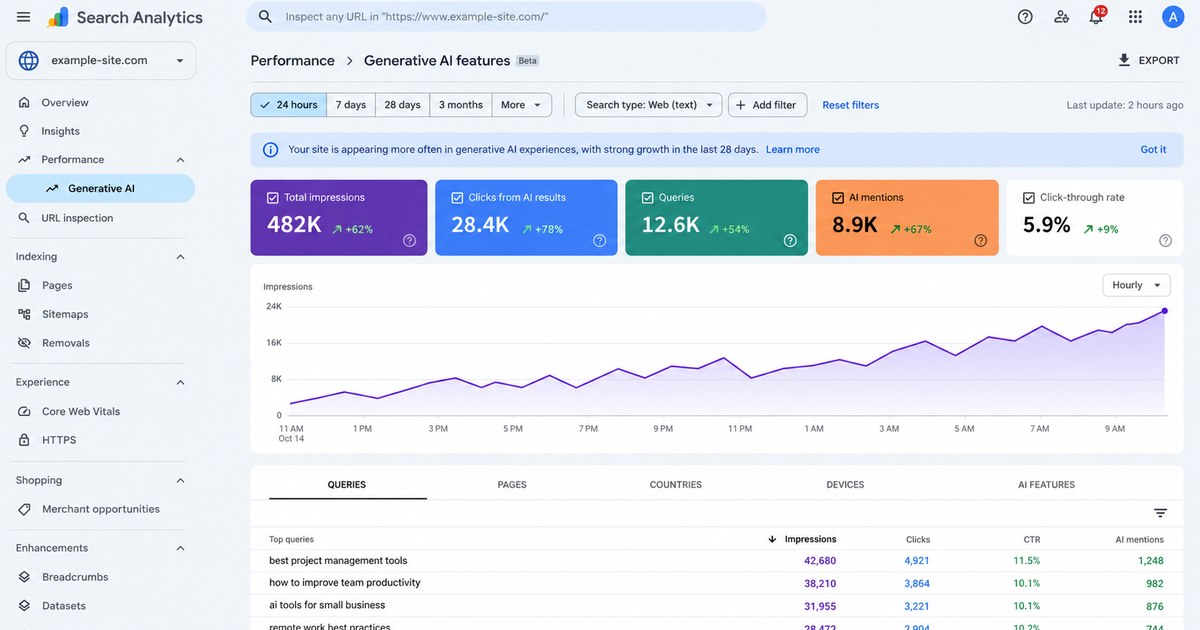
Google launched a Generative AI performance report in Search Console on June 3, 2026, giving site owners a first party view of impressions inside AI Overviews, AI Mode, and generative AI features in Discover, separate from the standard performance report. The bottom line: it shows how often your pages appeared in Google's AI features, it has no click data and no query detail, its data starts on May 18, 2026, and it ships with a property level opt out control, so use it as a directional signal and pair it with your own question tests.
New to the term? What is answer engine optimization covers the basics.
What it shows
The report sits under Performance in a section labeled Generative AI. It breaks impressions down by page, country, device for the Search version, and date, from hourly to monthly. It reports how often a page appeared inside a generative AI feature, not whether anyone engaged with it.
What it does not show
- Clicks. Google has not committed to a date for adding them.
- Query detail. You cannot see which user question triggered an appearance.
- History. Data starts May 18, 2026.
By comparison, Bing's AI Performance report, which launched almost four months earlier on February 9, 2026, exposes grounding queries. SEO analyst Koray Tugberk Gubur said Bing Webmaster Tools remained more transparent on AI visibility data even after Google's report shipped.
What our own report shows
In the three months to September 19, 2026, 334 pages on our site had at least one AI Overview impression, 922 in total. The pages with the most were not the ones we would have guessed.
| Page | AI Overview impressions |
|---|---|
| A GoHighLevel Meta leads integration article | 64 |
| The homepage | 31 |
/aeo-geo-seo | 23 |
| A Notion capabilities demo | 22 |
| A GoHighLevel versus Klaviyo SMS article | 21 |
| A GoHighLevel calendar booking article | 20 |
The lesson is the one Google's own guidance implies: AI features cite pages that answer specific questions well, whichever site section they sit in. Impressions are small numbers, and they are impressions, not visits.
The opt out control
Google introduced a property level Search generative AI control alongside the report. It lets an owner block content from appearing in generative AI features entirely, without affecting how it ranks in traditional results. Google states that opting out removes a site from generative AI traffic and impressions but is not used as a ranking signal elsewhere. The UK Competition and Markets Authority has set Google a deadline of March 2027 to introduce page level controls and expects click through data as part of that timeline. For most businesses trying to be found, opting out forfeits visibility in a growing share of queries.
How to use the report
- Verify the site in Search Console. A Domain property is the most complete.
- Open Performance, then Generative AI.
- Sort pages by impressions. These are the pages Google's AI features draw on.
- Compare with the standard report. A page with strong AI impressions and weak search impressions is being read and cited without driving many clicks.
- Study the winners. See what they share: specificity, structure, evidence.
- Improve the pages just below them. Add answers, numbers, and sources.
- Re check monthly. Keep a dated record, since there is no backfill.
Questions people ask
What is the Search Console generative AI report?
A report launched June 3, 2026 that shows impressions from Google's generative AI features, such as AI Overviews and AI Mode, separately from the standard performance report.
Does the report show clicks?
No. Google has not committed to a date for adding click data.
Should I opt out of Google's generative AI features?
For most businesses trying to be found, no. Opting out removes visibility in AI features without a ranking benefit elsewhere.
When does the data start?
May 18, 2026, with no historical backfill, so keep your own dated record.