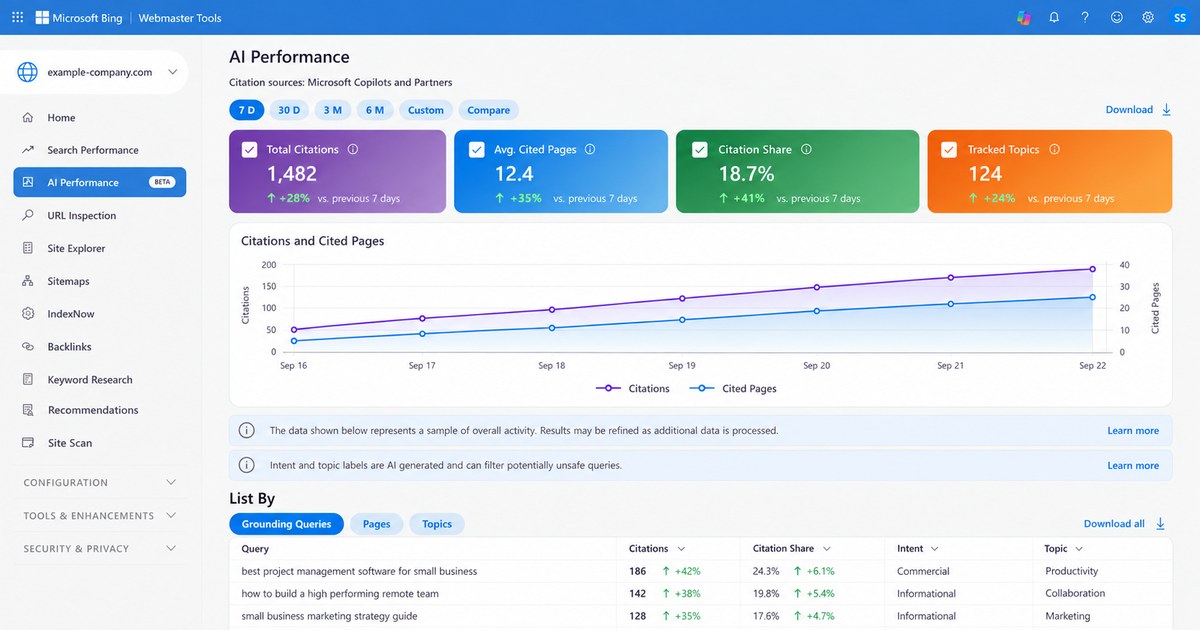
Bing Webmaster Tools launched an AI Performance report in public preview on February 9, 2026, four months before Google shipped anything comparable, and it remains the only first party report that shows the search phrases an AI system generated to find your content. The bottom line: it measures citations across Microsoft Copilot and Bing's AI summaries, it now groups them by intent and topic, it has no click data, and it covers only Microsoft's ecosystem, so use it as a directional signal alongside your own question tests.
For a full definition, read our answer engine optimization guide.
What launched, and what was added
| Date | What Microsoft shipped |
|---|---|
| February 9, 2026 | Public preview. Total Citations, Average Cited Pages per day, a citation activity timeline, and page level citation data, covering Copilot, AI generated summaries in Bing, and select partner integrations |
| June 16, 2026 | Intents, Topics, Citation Share, and Compare, moving the report from where you were cited toward why, and how activity compares over time |
Microsoft described the first release as an early step toward Generative Engine Optimization tooling and framed Citation Share as observational, not a ranking system, a competitive scoreboard, or a quality score. It does not expose competitor domains.
Grounding queries: the unique part
When Copilot retrieves web content to answer a question, it reformulates the question into cleaner, more specific retrieval phrases. Those internal phrases, called grounding queries, are what the report shows, not what the user typed. It is a rare view into the search language an AI system generates on its own, and Google's report has no equivalent. One publisher who tracked three months of data after verifying their site reported 647 unique grounding queries that led Copilot to their content, with more than 30,000 grounding events across 173 pages.
What it does not show
- Clicks. Microsoft says click data is not available in the report or the API and is on the roadmap.
- Anything outside Microsoft. It says nothing about ChatGPT, Perplexity, or Google AI Overviews, so Bing citation volume is not AI visibility in general.
- User prompts. Grounding queries are system generated.
How to use it
- Verify your site in Bing Webmaster Tools. Use the XML file, meta tag, CNAME, or import from Search Console.
- Open AI Performance from the left navigation. No separate signup or paid plan is needed.
- Read the grounding queries. They show how an AI system searches for your topics.
- Check which pages are cited. Compare with the pages you expected.
- Use Topics and Intents. See which subjects and purposes bring citations.
- Write for the gaps. Topics you should be cited for and are not need better pages.
- Cross check. Run your customer questions in Copilot and compare with the report.
Why it matters beyond Copilot
Bing's index is part of how ChatGPT search works. Seer Interactive found 87 percent of more than 500 SearchGPT citations matched Bing's top results. That does not make the AI Performance report a ChatGPT report, but getting indexed and well described in Bing supports visibility in more than Microsoft's own products.
Questions people ask
What is the Bing Webmaster Tools AI Performance report?
A report launched in public preview on February 9, 2026 that shows how often a site's content is cited across Microsoft Copilot, Bing's AI summaries, and select partner integrations.
What are grounding queries?
The internal search phrases Copilot generates to retrieve web content for an answer. They are not what the user typed.
Does the report show clicks?
No. Microsoft says click data is not available in the report or the API and is on the roadmap.
Does the report cover ChatGPT or Google AI Overviews?
No. It covers Microsoft's ecosystem only.