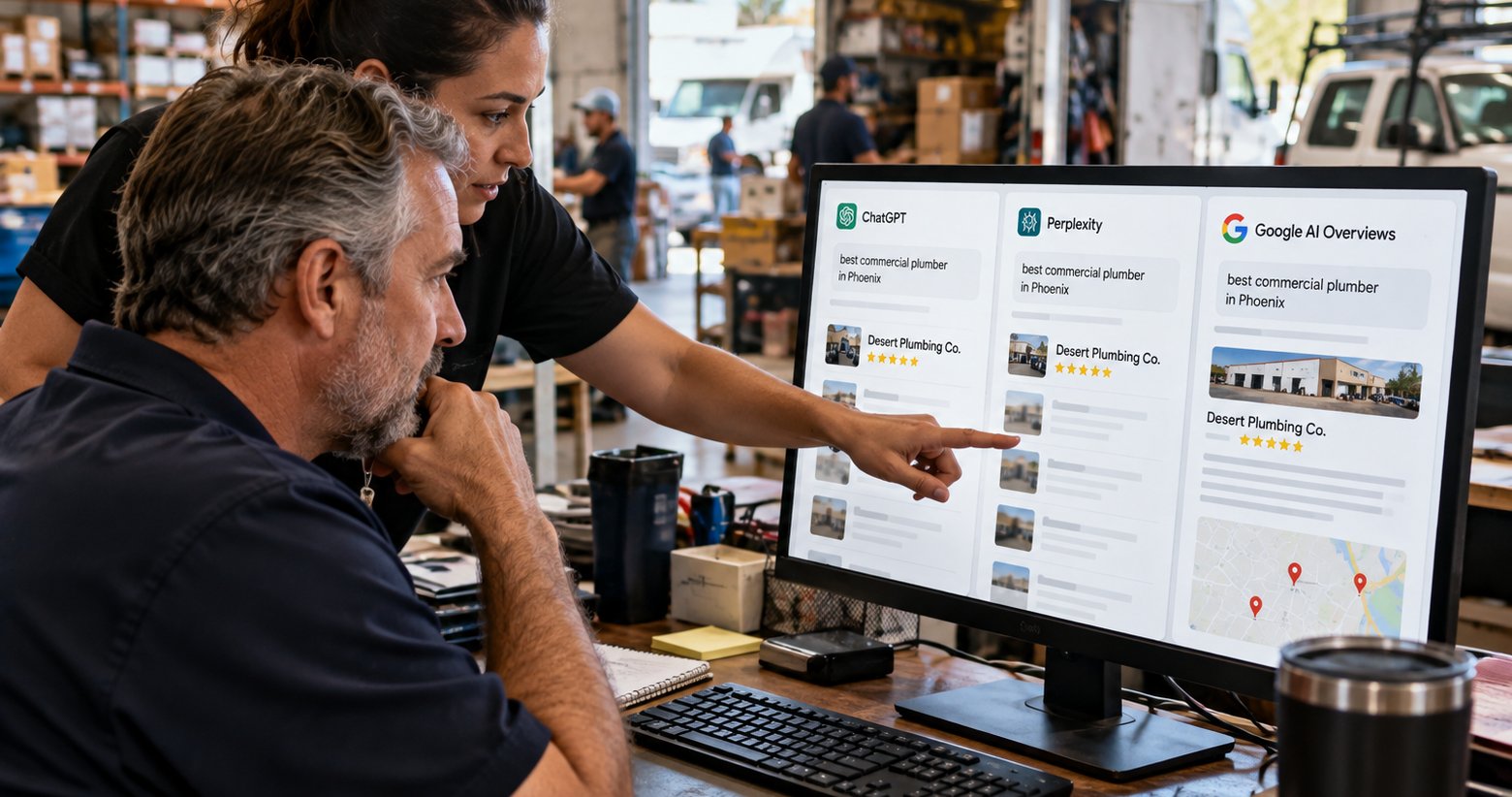
Free AI visibility checkers are not all measuring the same thing, and comparing them as if they were is the most common mistake people make with them. There are two different kinds. Readiness scanners read your website and score how easy it is for an AI system to crawl, parse, and use it. Outcome checkers ask the AI platforms real questions and record whether your brand actually shows up in the answers. The bottom line: run one of each. A readiness scan tells you what to fix, and an outcome check tells you whether the fixes are changing what customers see.
Related: our guide to answer engine optimization defines the term and lists eight steps.
Why the two kinds exist
An AI answer is the end of a pipeline. A page has to be crawlable, get retrieved for a specific question, be understood, and then be selected over the other pages retrieved alongside it. Selection is the narrow part. AirOps analyzed more than 548,000 pages that ChatGPT retrieved and found only about 15 percent of them appeared in the final response, a figure summarized by the search platform Quattr from the AirOps report. Retrieval is one filter and citation is a second, harder one.
Readiness scanners test the first filters, the ones you control by editing your own site: whether crawlers are allowed in, whether content exists in the HTML, whether structured data and headings are present. Outcome checkers test the last filter by running the questions and reading the answers. Neither one alone covers the pipeline.
The tools, side by side
| Tool | Kind | What it actually does | Signup | Limits worth knowing |
|---|---|---|---|---|
| Omni AI Visibility Scan | Readiness | Eight weighted checks on the page you enter: schema 22 points, server rendered content 18, meta tags 12, content density 12, robots.txt 10, llms.txt 10, headings 8, answer ready FAQ content 8. | None to run the scan | Reads one page and the files around it. Cannot see off site signals or whether any AI names you. |
| BlueGrid Media AI Visibility Checker | Readiness, plus a manual audit | An instant scan of 43 signals from the live page, robots.txt, llms.txt, and sitemap, plus a separate 11 signal weighted audit you complete by hand. | None | Built for contractors and local service businesses. The weighted 11 signal score is self reported. |
| Ahrefs Free AI Visibility Checker | Outcome | You enter a brand name. It queries ChatGPT, Gemini, Perplexity, Copilot, and Google AI Overviews and AI Mode with prompts derived from real Google searches, then shows mentions, a platform breakdown, topics, and the top cited domains and pages. | None | A limited preview of what Ahrefs Brand Radar tracks in full. Chatbot prompt coverage is far thinner than Google AI Overviews coverage. |
| Semrush AI Visibility Checker | Outcome | Draws on a database of more than 26 million prompts and responses across ChatGPT, Gemini, AI Mode, and AI Overviews. Shows platform coverage, an audience reach estimate, top cited pages, and best performing topics. | Free to use | Reports what is in Semrush's prompt database, so a small brand may have little data. |
| PromptRush Free AI Visibility Checker | Outcome | You enter a website and a market. It runs buyer style prompts through ChatGPT, Gemini, Perplexity, AI Overviews, and AI Mode and returns a visibility score and a top competitor ranking. | None for the instant score. A free account unlocks sources and per prompt answers. | Vendor reported customer claims only. Lists SaaS, ecommerce, retail, fintech, healthcare, and travel as its verticals. |
How much to trust each kind
Outcome checkers: one run is noise, many runs are signal
The strongest public evidence here is the SparkToro and Gumshoe study published in January 2026. About 600 volunteers ran 12 recommendation prompts through ChatGPT, Claude, and Google's AI features a combined 2,961 times, with each prompt repeated 60 to 100 times per platform. The result: there was less than a 1 in 100 chance that two responses returned the same list of brands, and roughly a 1 in 1,000 chance of the same list in the same order. The researchers concluded that any tool reporting your ranking position in AI answers is reporting noise, while how often a brand appears across many runs is far more stable. Ahrefs found something similar on the Google side: its research shows an AI Overview has about a 70 percent chance of changing between observations.
The practical rule: never judge your visibility from a single check. A tool that asks one question once, like the free checkers that cover a single prompt, can tell you whether you have a problem, not how big it is.
Readiness scanners: they measure inputs, and the evidence on inputs is mixed
A readiness score is a checklist of things that should help, not proof that they do. Ahrefs ran a controlled test comparing 1,885 pages that added JSON-LD schema against 4,000 control pages and found no meaningful increase in citations across AI Overviews, AI Mode, or ChatGPT. The limit of that study matters: every page in it was already being cited more than 100 times, so it says little about whether schema helps a page get noticed in the first place. BlueGrid Media states plainly that llms.txt is not yet a confirmed ranking factor for any single engine. Treat a readiness score as a fix list for the things you control, not a prediction.
How to use them together
- Run a readiness scan on your homepage and on one service page.
- Fix crawler access and server rendered content first. A page an AI crawler cannot fetch or read cannot be selected, whatever else is true about it.
- Run an outcome checker on your brand and your two closest competitors to see who is named and which sources are cited.
- Write down 10 questions a real customer would ask. Run each one five times on ChatGPT, Gemini, and Perplexity in fresh sessions, 150 runs in total, and log whether your business is named.
- Repeat the same 150 runs after each round of fixes and compare the share of runs that name you, not the position you were listed in.
Where our scan fits, and where it does not
Our scan is a readiness scanner. It reads one page and the files around it in about 10 seconds and scores eight checks. It cannot tell you whether any AI system currently names your business, which is why our managed plans monitor customer questions across ChatGPT, Gemini, Perplexity, Claude, and Google AI as a separate, ongoing step. The scan is the fast, free way to find what is blocking a page. The monitoring is how you find out whether fixing it changed anything.
Questions people ask
What is the difference between a readiness scanner and an outcome checker?
A readiness scanner reads your website and scores how easy it is for AI systems to crawl and use. An outcome checker asks AI platforms real questions and records whether your brand appears in the answers. Readiness tells you what to fix. Outcome tells you whether it is working.
Are free AI visibility checkers accurate?
Readiness scanners accurately report what is on your site, but a good score is not proof of citations. Outcome checkers are limited by how variable AI answers are, so a single run is unreliable and results should be judged across many runs.
How often should I re run an AI visibility check?
Re run the same set of questions after each round of fixes and at least monthly. Compare the share of runs that name your business rather than any single result.
Do I need an llms.txt file?
It is a low effort file that some scanners check for, but it is not a confirmed ranking factor for any single AI engine, so treat it as optional housekeeping rather than a priority.
Sources
- BlueGrid Media: AI Visibility Checker
- Ahrefs: Free AI Visibility Checker
- Ahrefs: Brand Radar methodology
- Ahrefs: AI Overviews Tracker
- Semrush: Free AI Visibility Checker
- PromptRush: Free AI Visibility Checker
- SparkToro: AIs are highly inconsistent when recommending brands
- Quattr: what Ahrefs' AI search research really tells us (summarizing the AirOps and Ahrefs schema studies)