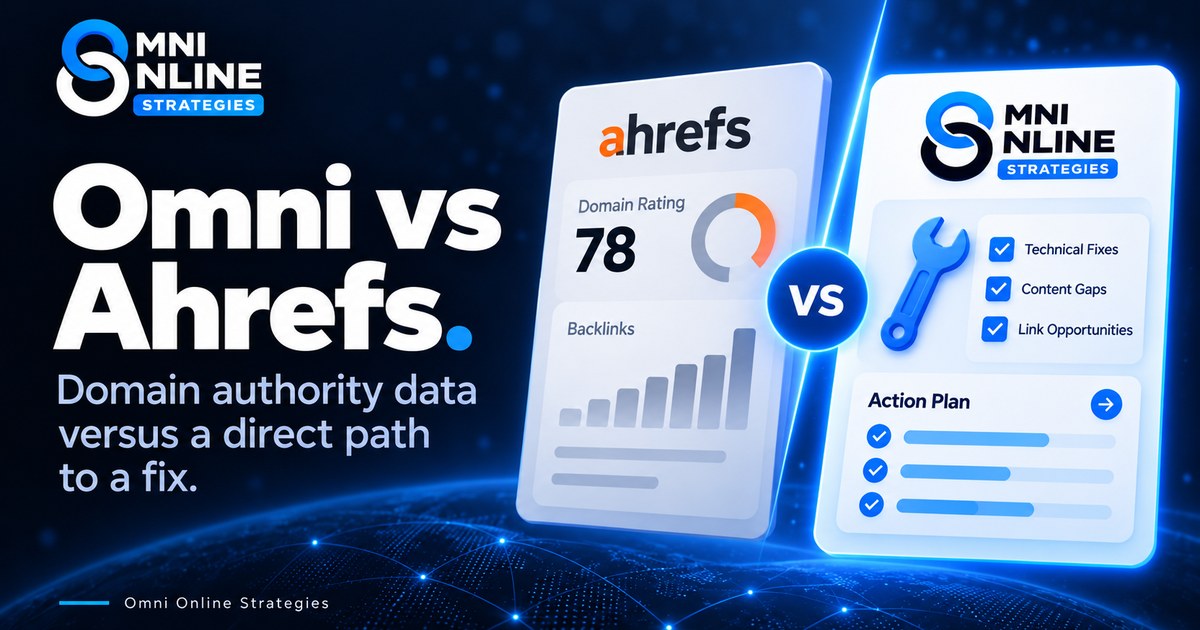
These two tools answer different questions. Ahrefs' free checker asks, "Do the AI platforms name my brand today, and which sources do they cite alongside it?" Our scan asks, "Can an AI crawler fetch and use this page?" One measures an outcome and the other measures readiness, so neither replaces the other. The bottom line: use the Ahrefs checker to see where you stand, use our scan to find what is blocking a page, and repeat both after every round of fixes.
Related: our guide to answer engine optimization defines the term and lists eight steps.
What Ahrefs' free checker actually does
You type a brand name, the way your audience would say it. Ahrefs then queries ChatGPT, Gemini, Perplexity, Copilot, and Google AI Overviews and AI Mode with what it calls search backed prompts, meaning questions derived from what people actually search on Google rather than made up questions. It checks whether each platform mentions your brand and returns a report with total AI mentions, a breakdown by platform, the topics that trigger mentions, and the top cited domains and pages. No signup is required.
Ahrefs is explicit that this is a limited preview. The full product, Brand Radar, tracks the same platforms with complete data, plus YouTube and Reddit visibility in beta, search demand, and web visibility reports. Ahrefs also draws a line that matters for reading any report: a mention means the platform named your brand, while a citation means it linked to your website as a source. Brand Radar tracks the two separately because they respond to different work.
Where the data comes from
Ahrefs' methodology page, dated June 16, 2026, explains that each query is run in the supported AI interfaces, the raw responses are stored, and users then search that stored corpus for citations, which are linked URLs, and mentions, which are string matches for a term. The prompts run through the free, publicly available web interfaces of the platforms to reflect a typical user's experience, and the mix of locales mirrors the ratio of queries by country and language in Ahrefs' keyword database.
| Platform | Approximate monthly prompts (Ahrefs methodology page, June 16, 2026) |
|---|---|
| Google AI Overviews | 282 million |
| Google AI Mode | 24 million |
| Perplexity | 14.6 million |
| Gemini | 14.6 million |
| ChatGPT | 14.5 million |
| Copilot | 13.3 million |
| Grok | 13 million |
Ahrefs' own pages show different totals depending on the page and the date, roughly 240 million to 350 million prompts a month, so treat these figures as approximate. The shape is consistent, though, and it is the most important thing to understand about this data.
The real limits of the data
- Coverage is deepest on Google. On the methodology page, Google AI Overviews carries roughly 18 to 19 times as many monthly prompts as ChatGPT, depending on which Ahrefs page you read. If your customers mostly use a chatbot, the chatbot sample behind your report is far thinner than the Google sample.
- The prompt set is national, not local. The methodology describes localization by country and language. It does not describe city level question sets. A business whose customers ask "who can fix this tonight near me" may find few of its real questions in the index, so a low result can mean the prompt set never asked.
- Mentions are string matches. A brand whose name is a common word can collect matches that are not about the brand, and a brand with several spellings can miss some.
- The answers move. Ahrefs' research found an AI Overview has about a 70 percent chance of changing between observations, and separate Ahrefs research reported by Search Engine Journal found Google's AI Mode and AI Overviews cite different sources 87 percent of the time for the same query. In the SparkToro and Gumshoe study of 2,961 runs, there was less than a 1 in 100 chance two responses returned the same brand list. One snapshot is a sample, not a verdict.
- Refresh rates are disputed. Profound, a competing vendor, states that Ahrefs updates chatbot data monthly, apart from AI Overviews, while its own data updates hourly. Treat that as a competitor's claim, and check Ahrefs' current documentation for its refresh schedule before relying on trend lines.
What our scan does that Ahrefs' checker does not
Ahrefs' checker shows outcomes and the sources around them, but it does not test whether your own page can be fetched and read. Our scan reads the page and applies eight fixed checks: JSON-LD schema, server rendered content, meta tags, concrete fact density, robots.txt access for seven AI search and user fetch bots, llms.txt, heading structure, and answer ready content. A page that blocks OAI-SearchBot or ships its text through JavaScript will fail those checks regardless of what any outcome report says, and those failures are cheap to fix.
| Ahrefs free checker | Omni scan | |
|---|---|---|
| Question it answers | Do AI platforms name my brand? | Can AI crawlers fetch and use this page? |
| Input | A brand name | A page URL |
| Kind of measurement | Outcome | Readiness |
| Platforms covered | ChatGPT, Gemini, Perplexity, Copilot, AI Overviews, AI Mode | Crawler access rules for 16 AI bots, seven of which decide the result |
| Shows competitors | Through cited domains and pages | No |
| Shows why | Partly, through cited sources | Yes, per check, with the rule that failed |
| Signup | None | None to run the scan |
Reading the two together
| What you see | What it likely means | What to do |
|---|---|---|
| Named by AI, and our scan passes | Readiness is not the constraint right now. | Protect it. Recheck monthly and after site changes. |
| Named by AI, but our scan fails robots.txt or server rendering | Mentions may be coming from third party pages, and your own pages cannot be fetched to answer a live question. | Fix crawler access and rendering first. |
| Not named, and our scan passes | The site is readable but nothing is selecting it. The gap is usually corroboration and topic coverage. | Study the cited domains in the Ahrefs report and build presence there. |
| Not named, and our scan fails | Two problems at once. | Fix readiness first, then remeasure. |
How to run this in one sitting
- Run the Ahrefs free checker on your brand and on your two closest competitors.
- Write down the top cited domains it lists for each. These are the sources shaping the answers in your category.
- Run our scan on your homepage and one service page and fix any failing robots.txt or server rendering check.
- Take 10 real customer questions, run each five times on ChatGPT, Gemini, and Perplexity in fresh sessions, and log how often your business is named. This covers the local, specific questions the national prompt set can miss.
- Repeat step 4 after each round of fixes and compare the share of runs that name you.
Questions people ask
Is Ahrefs' free AI visibility checker really free?
Yes. It needs no signup and gives a limited preview of what Ahrefs Brand Radar tracks in full.
Which AI platforms does the Ahrefs checker cover?
ChatGPT, Gemini, Perplexity, Copilot, Google AI Overviews, and Google AI Mode.
What is the difference between an AI mention and an AI citation?
A mention means the platform named your brand in its answer. A citation means it linked to your website as a source. Ahrefs tracks the two separately because they take different work to earn.
Does the Ahrefs checker show why my brand is not mentioned?
Not directly. It shows outcomes and the domains and pages cited alongside brands in your space, which points to where corroboration is coming from, but it does not test whether your own site is readable by AI crawlers.