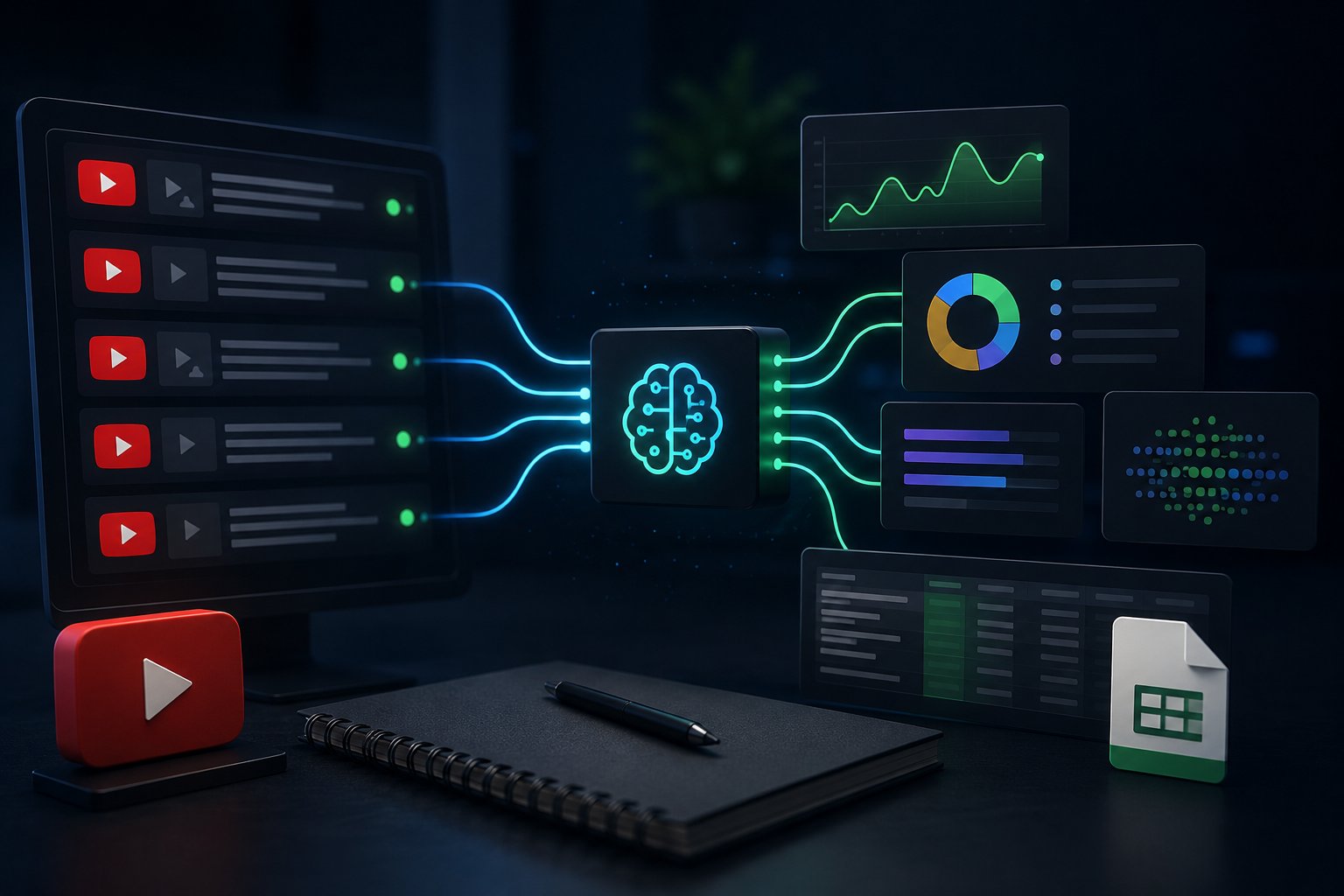
Scheduled YouTube Intelligence YouTube competitor video feed flowing through glowing circuits into a central AI analysis hub, which outputs analytics charts, structured data tables, and a Google Sheets export — visualizing an automated YouTube competitor intelligence monitoring system.

Competitors Publish.
You Get the Briefing.

Automated weekly monitor for up to 6 YouTube channels. New videos, full transcripts, AI topic extraction, and content gap analysis in one CSV.

Built for SaaS, agencies, professional services, and any B2B team that needs to know what competitors are saying before they say it again.

Trigger: Every Monday Channels: Up to 6 Window: Last 7 days Output: CSV + gap report
1Channel Monitor

It runs every Monday and pulls every new video.

The workflow loops through your competitor channel list, hits the YouTube Data API, and returns all videos published in the last 7 days. View counts, titles, publish dates, and video IDs are captured for every result.

n8n.cloud / workflows / yt-competitor-monitor / executions / weekly-run
YTYouTube Competitor Monitor — Weekly Pull
Idle — last run Sun 11:59 PM
📅 Window: Last 7 days 📹 Channels: 6 📺 Min views: 500 Videos found: 0
Channel Video Title Published Views Topics
Hit “Run weekly monitor” to pull this week’s videos
2Transcript & AI Analysis

Every video gets a full transcript and an AI breakdown.

For each video pulled, the workflow fetches the full transcript via the YouTube transcript API. That transcript goes to the AI with a structured prompt: extract the primary topic, messaging angle, key claims, and audience this video targets.

Run the monitor first
openai.com / v1 / chat / completions — transcript-analyzer-prompt
Run the monitor above first, then analyze
3Content Gap Finder

What are competitors not covering? That’s your opening.

After AI analyzes all transcripts, a second pass compares topic coverage across all 6 channels. Topics appearing in fewer than 2 channels are flagged as gaps. Topics appearing in 4 or more are labeled as saturated — owned by the category.

Gap analysis runs after AI analysis completes
4CSV Export

Everything structured. Ready for your content team.

The workflow dumps all data into a CSV: channel, video title, publish date, view count, transcript excerpt, primary topic, messaging angle, audience target, and gap flag. One file, every Monday.

📄 competitor-intelligence-2024-W47.csv
channel,video_title,published,views,primary_topic,messaging_angle,audience,gap_flag
HubSpot,Why Your CRM Data Is Lying to You,2024-11-18,42800,CRM data hygiene,Fear of bad decisions from dirty data,Sales managers,false
Salesforce,AI in Sales: What Actually Works,2024-11-19,31200,AI sales tools,Practical results over hype,VP of Sales,false
Gong,The Cold Call Script That Books 30% More,2024-11-20,58900,Cold calling,Script + framework with proof stat,SDRs,false
Outreach,Pipeline Reviews Are Broken. Here’s Why,2024-11-17,19400,Pipeline management,Contrarian: current process wastes time,Sales Directors,true
ZoomInfo,Finding the Right Buyer Persona in 2025,2024-11-21,27600,ICP definition,Data-driven persona building,RevOps,false
Apollo,Sequencing That Doesn’t Get Ignored,2024-11-18,44100,Email sequences,Pattern interrupt subject lines,SDRs & AEs,false
5How It Runs

One workflow. No manual work after setup.

The entire system runs inside n8n on a Monday morning schedule. Six nodes handle the end-to-end process from API call to CSV file in your inbox.

Schedule Trigger
Fires every Monday at 7 AM
Channel List
Loops through your 6 competitor channel IDs
YouTube API
Fetches last 7 days of videos per channel
Filter 7 Days
Removes videos outside the window and below view threshold
Fetch Transcript
Pulls full video transcript via YouTube transcript API
AI Analysis
Extracts topic, angle, audience, and gap signals
Export + Email
Structured CSV delivered to your inbox every Monday
6Coverage Calculator

See how much competitive surface you cover per week.

Adjust the inputs to match your competitive landscape. See how many videos, topics, and gap signals the system captures each week.

Channels monitored6
Avg videos per channel per week3
% of videos with transcripts available80%
18
Videos tracked per week
14
Transcripts analyzed
4
Avg gap signals surfaced
7Scope of Work

What we build. What you do with it.

💻 We Build
  • n8n workflow with schedule trigger
  • YouTube Data API integration
  • Transcript extraction pipeline
  • AI analysis prompt and node
  • Gap detection logic
  • CSV export and email delivery
  • Channel list config panel
📋 You Provide
  • List of competitor channel URLs or IDs
  • Minimum view count threshold
  • Topics to exclude from gap analysis
  • Delivery email address
  • YouTube Data API key (free tier)
🚫 Not Included
  • Video thumbnail downloads
  • Comment analysis
  • Channel subscriber tracking
  • Automated content creation from gaps
  • LinkedIn or social distribution
Data note: This demo uses simulated channel and video data for illustration. The actual workflow uses the official YouTube Data API v3, which provides public video metadata and captions. Transcript availability depends on whether the channel owner has enabled captions. API usage is subject to YouTube’s standard quota limits.
Josh Leavitt, Founder of Omni Online Strategies
From the Founder
“Your competitors are publishing their strategy on YouTube every week. The transcript is right there. Most teams never read it. This system reads all of them.”
Most B2B content teams guess at what the market wants. This system tells you exactly what your competitors are saying, in their own words, every single Monday morning before you write a single line.
Josh Leavitt
Founder and CEO, Omni Online Strategies

Want this running on your competitors?

We configure the channel list, build the workflow, and deliver your first briefing within a week.

Set up my intelligence monitor
Requires YouTube Data API key (free). No additional subscriptions needed.
What This Is
YouTube Competitor Intelligence Monitor

The YouTube Competitor Intelligence Monitor is an automated weekly workflow that tracks up to six competitor YouTube channels, retrieves every video published in the past seven days, extracts full transcripts, and runs AI analysis to identify primary topics, messaging angles, and audience targets. A second AI pass compares coverage across all channels and flags content gaps — topics that no competitor is addressing. All output is delivered as a structured CSV every Monday morning. The system runs inside n8n on a schedule trigger with no manual intervention after initial setup.

AttributeDetail
Problem solvedManual competitor content research is slow, inconsistent, and typically skipped. Teams miss topic trends and publish content that duplicates what competitors already own.
Channels monitoredUp to 6 YouTube channels per workflow instance. Additional instances can be stacked for broader coverage.
Update frequencyWeekly, triggered every Monday at a configurable time. Covers videos published in the prior 7-day window.
Data capturedChannel name, video title, publish date, view count, full transcript, primary topic, messaging angle, audience segment, and content gap flag.
Tools usedn8n (workflow automation), YouTube Data API v3 (video metadata and captions), OpenAI or compatible LLM (transcript analysis and gap detection), email or Slack node (delivery).
Output formatStructured CSV delivered to a designated email address. Optionally posted to a Slack channel or appended to a Google Sheet.
Industries servedSaaS, digital agencies, professional services, B2B technology, financial services, healthcare technology, logistics and supply chain.
Setup timeTypically 3 to 5 business days from channel list submission to first automated delivery.
How It Works
Step-by-step process
  1. Schedule trigger fires every Monday at 7 AM. The n8n workflow activates on a cron schedule. No manual action is required after the initial configuration.
  2. The workflow loops through the configured channel list. Each competitor channel ID is processed in sequence. The list is editable inside the workflow without touching any code.
  3. The YouTube Data API is called for each channel. The API returns all videos published within the last 7 days, including video ID, title, publish date, view count, and description.
  4. A filter node removes videos below the view threshold. Only videos meeting the minimum view count are passed downstream, reducing noise from low-traction content.
  5. Full transcripts are fetched for each qualifying video. The workflow retrieves the auto-generated or manually uploaded transcript for each video. Transcript availability is subject to the channel owner’s caption settings.
  6. The AI analysis node processes each transcript. A structured prompt instructs the LLM to extract the primary topic, core messaging angle, audience target, key claims, and any notable tactics used in the video.
  7. A second AI pass runs gap detection across all results. The combined analysis from all channels is sent to the LLM, which identifies topics appearing in fewer than two channels as potential content gaps and topics appearing in four or more as saturated.
  8. Results are compiled into a structured CSV and delivered. The final file is emailed to the configured recipient and optionally posted to a Slack channel or written to a Google Sheet row for historical tracking.
Frequently Asked Questions
Common questions about YouTube competitor monitoring
What does a YouTube competitor intelligence monitor actually do? +
It runs on a schedule, pulls every new video from a list of competitor YouTube channels, retrieves full transcripts, and uses an AI model to extract the topic, messaging angle, and audience each video targets. The results are delivered as a structured CSV so your content team can see exactly what competitors are publishing each week without manually watching every video.
How many YouTube channels can one workflow monitor? +
A single workflow instance handles up to 6 channels comfortably within YouTube Data API quota limits. If you need to monitor more than 6 competitors, additional workflow instances can be configured with separate channel lists and run in parallel.
Does the YouTube Data API require payment? +
No. The YouTube Data API v3 is free to use and includes 10,000 units of daily quota at no cost. Monitoring 6 channels with an average of 3 videos per week uses a small fraction of the free quota. The API key is created inside Google Cloud Console in under 10 minutes.
What is a content gap in this context? +
A content gap is a topic that is relevant to your category but not being addressed by competitors on YouTube. The system identifies gaps by comparing topic coverage across all monitored channels. If fewer than two competitors have covered a topic in the past several weeks, it surfaces as a gap. These gaps represent publishing opportunities where you can establish presence without competing directly against established content.
Are YouTube video transcripts always available? +
No. Transcript availability depends on whether the channel has auto-captions enabled or has uploaded manual captions. The majority of business and professional YouTube channels have auto-captions active, which the API can retrieve. Videos without any captions are still captured with their metadata but are excluded from the transcript analysis step.
How is the competitor channel list configured? +
The channel list is stored as a JSON array inside the n8n workflow. Each entry is a YouTube channel ID, which can be found in the channel’s URL or About page. Updating the list requires editing one node in the workflow. No code changes are needed.
Can the output go to Google Sheets instead of email? +
Yes. The workflow can be configured to append each week’s results as new rows to a Google Sheet, in addition to or instead of email delivery. This creates a running historical record of competitor content that can be filtered, sorted, and analyzed over time. A Slack notification can also be added to alert the team when new results land.
What AI model analyzes the transcripts? +
The workflow uses the OpenAI API by default, with a structured prompt that instructs the model to return a consistent JSON output for every video. The prompt is configurable and compatible with any OpenAI-compatible model endpoint, including Azure OpenAI, Anthropic Claude via API, or local models running on LM Studio.
How quickly can this be set up and delivering results? +
Setup takes 3 to 5 business days from the time you provide the competitor channel list and a YouTube Data API key. The first automated delivery runs on the following Monday. After that, the workflow runs without any action from your team.
What industries use competitor YouTube intelligence systems? +
Any industry where competitors are active on YouTube and publish content that informs buyer decisions. The most common use cases are SaaS companies tracking product positioning from competitors, B2B agencies monitoring category thought leaders, professional services firms following industry educators, and financial technology companies watching how competitors frame regulatory and product topics.
Sources & References
Research behind this system
[1]YouTube processes over 500 hours of video uploaded per minute as of 2022. For B2B categories, this means competitor publishing cadence has accelerated significantly. Source: YouTube Official Blog
[2]The YouTube Data API v3 documentation provides full reference for the search.list and captions.list endpoints used in this workflow. Free tier quota is 10,000 units per day. Source: Google Developers — YouTube Data API v3
[3]Content gap analysis as a competitive strategy is documented in HubSpot’s SEO and content marketing research. Identifying underserved topics consistently produces higher organic and social engagement rates than publishing against established competitor content. Source: HubSpot Marketing Blog — Content Gap Analysis