Steel welding is governed by AWS D1.1, and a fabricator or erector that does not read the welding procedures and inspection requirements underprices the labor and the quality control.
What AWS D1.1 sets
AWS D1.1, the Structural Welding Code for steel, governs the welding procedures, the welder qualifications, and the weld inspection on structural steel. A steel package references AWS D1.1 to set the weld types, the procedure specifications, and the visual and nondestructive testing the fabricator and erector must perform and document.
Why welding scope is easy to misprice
The weld types, the procedure and welder qualifications, and the inspection and nondestructive testing sit in the Division 05 specifications, not the title. A sub that underreads the inspection or testing carries the wrong quality control labor into the bid.
How the D1.1 Edition and the Steel QC Plan Change the Price
AWS D1.1 covers the design of welded connections, qualification of welding procedures and personnel, fabrication, inspection, and stud welding. AWS notes that when a contract lists a code by reference, every requirement in it becomes a contract requirement. The bid package therefore sets the edition, and the edition sets the work. AWS released D1.1/D1.1M:2025 on April 17, 2025, and its authors describe changes in most clauses compared with the 2020 edition, so a package written to the 2020 edition and one written to the 2025 edition are not the same scope.
Inspection cost usually comes from a second document. AISC 360 Chapter N sets the quality control, quality assurance, and nondestructive testing minimums for structural steel buildings, and Section N2 requires the fabricator and erector to run their own quality control procedures. Chapter N, which AISC introduced in the 2010 edition, includes ultrasonic testing of a sample of complete joint penetration groove welds. Project specifications can require more than that sample. One structural steel specification posted on the City of Everett, Washington records portal calls for ultrasonic testing of 100 percent of complete penetration welds and 100 percent of partial penetration column splice welds.
| Where to look | What to extract | Effect on the bid |
|---|---|---|
| Division 05 specification | The AWS D1.1 edition, and any AISC 360 or AISC 341 reference | Sets the procedure, qualification, and inspection rules |
| Testing paragraph | The percentage of complete penetration welds to test by ultrasound, and who pays for the testing | Sets the quality control labor and the repair allowance |
| Welding procedures | Prequalified procedures versus procedures that need qualification testing | Sets the up front testing cost before the first weld |
The bottom line: the difference between testing a sample of complete penetration welds and testing all of them is a large labor and repair line, and it appears in the testing paragraph, not the title. Our agent extracts the D1.1 edition and the testing percentage from each steel package so the fabricator prices the inspection the specification actually requires.
How an AI bid agent reads welding requirements
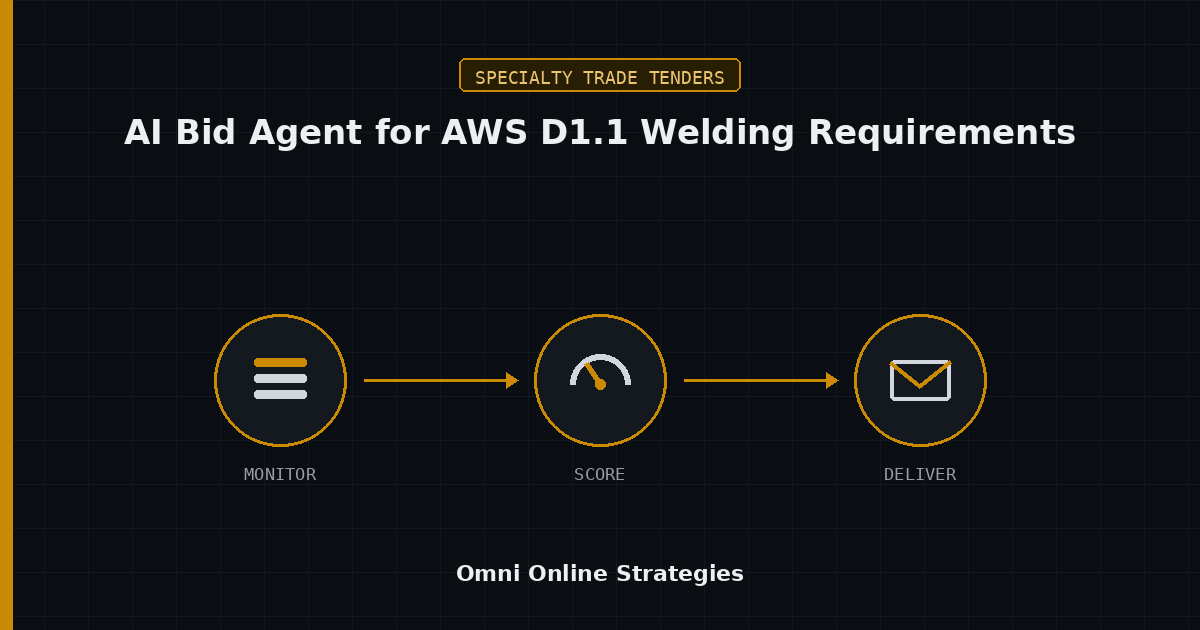
An AI bid agent reads each steel package, identifies the AWS D1.1 welding and inspection scope, and surfaces the weld types, the qualifications, and the testing that drive the work. The fabricator and erector price the actual quality control.
You can see how the agent reads a steel package in our AI bid agent demo for specialty trade contractors. It pulls the AWS D1.1 welding and inspection scope so the quality control is priced.