AI Search Optimization · AEO + GEO + SEO

Your Business Is
Invisible to AI.
We Fix That.

40 percent of search queries now get answered by AI without a click. ChatGPT, Perplexity, and Google AI Overviews cite specific sources. If yours is not one of them, you do not exist to an entire generation of buyers. Omni builds the content architecture and technical infrastructure that puts you in the answer.

Get a Free AI Visibility Audit → See How It Works
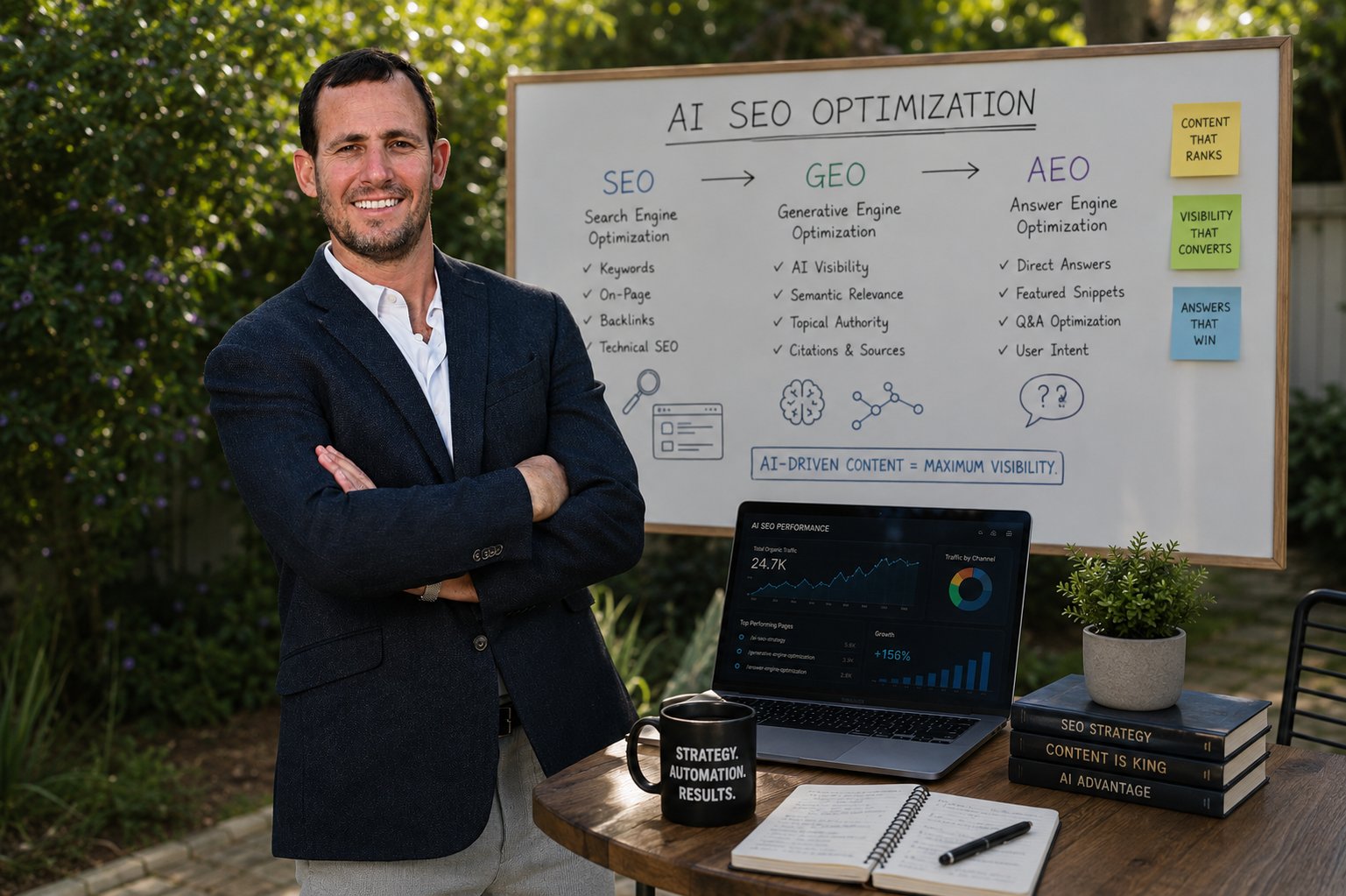
AI SEO, GEO, and AEO optimization strategy — Search Engine Optimization, Generative Engine Optimization, and Answer Engine Optimization framework by Omni Online Strategies
Omnionlinestrategies.com runs on this exact system
✦ 300+ AEO-structured articles live
✦ Built with Claude AI and Vercel
40%+
queries answered by AI with zero click-through
10+
JSON-LD schema types that signal AI readability
300+
topical authority articles in Omni's AI-indexed blog
3
disciplines — SEO, GEO, AEO — built as one system
The Shift

AI Search Is Not Coming.
It Is Already Here.

The businesses getting into AI answers right now are the ones that will own the category for the next decade. The ones waiting are watching their competitors get cited while they do not.

40%+
of search queries now get AI-generated answers
Google AI Overviews appear at the top of results for hundreds of millions of queries daily — above every organic link and every ad. The user sees the answer before they see any website.
$0
per click — AI citations drive awareness, not traffic
Being cited in an AI answer puts your brand in the buyer's research at zero cost per impression. Buyers who hear your name in three AI answers before any sales contact convert at higher rates and close faster.
2026
is the inflection year — most companies are not ready
Topical authority and structured data take 3 to 6 months to produce consistent AI citations. The companies that start now will be entrenched in AI answers before most competitors have begun.
10×
faster to build AI visibility than traditional SEO authority
A 30-article topic cluster built in 6 weeks can produce AI citations within 60 days. Building the same traditional SEO authority through backlinks and domain age takes years. The window is open right now.
The Framework

SEO Was One Discipline.
Now There Are Three.

Google still matters. AI answer engines matter more every month. Both require a fundamentally different technical and content approach. We build all three as a single coordinated system.

Still Essential
SEO
Search Engine Optimization
Keyword targeting and on-page structure
Technical crawlability and site speed
Core Web Vitals and mobile optimization
Internal linking and site architecture
Google Search Console + Bing Webmaster setup
The Bridge
GEO
Generative Engine Optimization
Topical authority and semantic depth
Entity definition and brand knowledge graph
20–50 article topic clusters per domain
Content AI language models draw from
Citation-worthy source credibility signals
New Priority The New Frontier
AEO
Answer Engine Optimization
FAQPage, Article, HowTo, Service schema
Question-and-answer content architecture
Direct citation by ChatGPT, Perplexity, Claude
Google AI Overviews featured placement
IndexNow auto-submission infrastructure
The Problem

Your Competitors Are Being
Cited. You Are Not.

AI answer engines do not show every website. They cite specific sources they have determined to be authoritative, structured, and readable. Most websites fail all three tests without knowing it.

0

No Structured Data

Most websites have no JSON-LD schema markup at all. AI systems use structured data to identify what a page is about, who published it, and whether it is authoritative enough to cite. Without it, the content is invisible to AI extraction systems even if it ranks well on Google.

Weak

Thin Topical Authority

A single page about a topic does not signal authority to AI systems. A cluster of 20 to 50 deeply specific articles about the same domain — each internally linked, each with proper schema — signals the topical authority that gets your brand into AI training and retrieval data.

Slow

Poor Content Discovery

New content that is not submitted to search indices immediately is not indexed. IndexNow protocol submits every new URL to Bing and connected search engines within seconds of publication. Most sites still wait for passive crawl — which can take weeks.

Wrong

SEO Without AEO

Traditional SEO optimizes for ranked links in a results page. AEO optimizes for direct citation in an AI-generated answer where no link list appears. The content structure, heading hierarchy, answer density, and schema requirements are fundamentally different — SEO alone does not achieve AEO visibility.

Our System

What We Actually Build

Not an audit report. Not a list of recommendations. A complete technical and content system — deployed, live, and measurable. Built on the same stack we used for this website.

Foundation Layer
Structured Data Architecture — JSON-LD Schema on Every Page Type
Every page type gets the appropriate schema. Blog articles get Article schema with author, publisher, datePublished, and wordCount. Service pages get Service and Organization schema with entity identity. FAQ sections get FAQPage schema for direct AI extraction. How-to content gets HowTo schema. All schemas are implemented as JSON-LD in the page head — the format AI systems and Google parse most reliably — and validated through Google's Rich Results Test.
Page type → Schema mapping:
  Blog articles   → Article + BreadcrumbList + FAQPage (if applicable)
  Service pages   → Service + Organization + FAQPage
  How-to content  → HowTo + Article
  Demo/tool pages → SoftwareApplication + FAQPage
  Homepage        → Organization + WebSite + SearchAction
GEO Layer
Topical Authority Clusters — 20 to 50 Articles Per Target Domain
For each target domain, we build clusters of 20 to 50 AEO-optimized articles targeting the specific questions AI tools are asked in that space. Each article answers one distinct real-user question, with Article schema, question-based H2 headings, direct answers in the first sentence of each section, and a FAQ block with FAQPage schema. Articles are stored in Supabase and published through the automated content pipeline. The cluster collectively creates the topical authority signal that AI systems read as expertise.
Discovery Layer
IndexNow Auto-Submission — New Content Indexed in Hours, Not Weeks
IndexNow is an open protocol that allows sites to push new URLs to Bing, Yandex, and connected search engines immediately upon publication. We implement IndexNow via GitHub Actions — every time new HTML is committed to the main branch, the sitemap auto-regenerates and IndexNow submits all new URLs automatically. Content that previously took 2 to 3 weeks to appear in AI retrieval systems now appears in hours.
Trigger: push to GitHub main branch
→ scripts/generate-sitemap.js runs automatically
→ GitHub Action submits all new URLs to IndexNow API
→ Bing + connected engines prioritize crawl
→ Content available in Perplexity, Bing Copilot within hours
Technical Layer
Next.js + Vercel — Static HTML for Maximum AI Crawler Compatibility
The site runs on Next.js deployed on Vercel with static HTML generation for all content pages. Static HTML is the highest-compatibility format for AI crawler systems — no JavaScript rendering required, no content hidden behind fetch calls, clean semantic HTML structure from every URL. Every page loads in under 200ms from Vercel's global CDN. Every content page has the correct canonical tag, og tags, Twitter cards, and meta description baked in at build time.
Entity Layer
Organization Knowledge Graph — Making Your Brand an Entity AI Recognizes
AI language models work with entities — named things with defined relationships and attributes. A business properly defined as a schema.org Organization entity, with consistent NAP data, founder identity, legal name, service definitions, and sameAs links to authoritative profiles, is more likely to be recognized and cited as a specific entity in AI answers than a business that is just a collection of web pages. We implement the full entity definition stack and verify it in Google's Knowledge Panel testing tools.
Content Backend
Supabase Content Pipeline — Scalable Article Publishing at Cluster Speed
Managing 50 articles per topic cluster through a traditional CMS is impractical. We connect a Supabase Postgres backend to the Next.js build pipeline so articles can be inserted programmatically — via API, via n8n automation workflows, or via AI-generation pipelines — with structured data fields managed consistently at the database level. Every article published through the pipeline automatically gets the correct Article schema, canonical URL, og tags, and FAQ block.
Measurement
AI Visibility Engine — Weekly Citation Monitoring Across All Major Platforms
We run an automated AI visibility monitoring workflow that queries GPT-4o, Claude, Gemini, and Perplexity with your target questions weekly and records whether your brand is cited in the responses, which sources are cited instead, and how citation patterns change over time as the content system matures. This turns a traditionally invisible channel into a trackable metric with a trend line.
Tools We Use

The Technology Stack

Every tool in this stack is something we use ourselves — on this site. Not tools we evaluated. Tools we deploy daily and know completely.

🤖
Claude AI
Content generation, HTML authoring, schema implementation, GitHub commits. The primary build partner for this entire website.
Next.js + Vercel
Static HTML generation and global CDN deployment. Every page is pre-rendered at build time for maximum AI crawler compatibility.
🗄️
Supabase
Postgres-backed content backend for programmatic article publication at cluster scale. Feeds the Next.js build pipeline directly.
Automation orchestration for AI visibility monitoring, content workflow pipelines, and IndexNow submission management.
📡
IndexNow + GitHub Actions
Instant URL submission on every deployment. Every new article is in Bing's index — and Perplexity's retrieval pool — within hours of publication.
🔍
Schema.org + JSON-LD
The global structured data standard. Article, FAQPage, HowTo, Organization, Service — deployed on every relevant page type, validated after every deploy.
Live Case Study

This Website Is the Proof

We did not describe the system — we built it and ran it on our own domain. Everything Omni delivers to clients is already running on omnionlinestrategies.com.

What We Deployed on This Site — and What It Produced
The Omni site runs on Next.js deployed to Vercel, with content stored in and served from Supabase. Every blog article has Article schema, canonical tags, og tags, and a unique meta description generated at build time. Every service page has Service and Organization schema with full entity definitions. The blog has over 300 articles across 15+ topical clusters targeting AEO-optimized question-based titles. IndexNow auto-submits on every GitHub push via GitHub Actions. A weekly AI Visibility Engine queries four AI models with target industry questions and logs whether Omni appears in the answers.
The entire infrastructure was built with Claude AI as the development partner and Vercel MCP for deployment — which means we understand exactly what these tools see and how they process content. When we recommend a structured data pattern or a content architecture to a client, we have run it ourselves at production scale.
300+
AEO-structured articles live
15+
topical authority clusters
10+
JSON-LD schema types deployed
<2hr
avg index time via IndexNow
Comparison

AEO + GEO vs Traditional SEO
vs Doing Nothing

Here is exactly what each approach gets you — and what it leaves on the table.

Capability
Traditional SEO Only
AEO + GEO + SEO (Omni)
Ranks in Google organic results
Cited in Google AI Overviews
Sometimes
✓ Structured for this
Cited by ChatGPT with browsing
Cited by Perplexity AI
Rarely
✓ IndexNow-fed
FAQPage schema for direct extraction
✓ Every article
Topical authority clusters (20–50 articles)
✗ Usually scattered
✓ Designed architecture
Organization entity definition
✓ Full schema
Content indexed in hours not weeks
✗ Passive crawl
✓ IndexNow on every deploy
AI citation tracking and reporting
✓ Weekly AI Visibility Engine
How It Works

What Working With Omni
on This Actually Looks Like

Three phases, defined deliverables at each stage, no multi-month onboarding before anything ships.

Phase 01 — Week 1
AI Visibility Audit
We audit your existing site for structured data gaps, topical authority depth, content extractability, and entity definition. We run your target queries across ChatGPT, Perplexity, and Google and document exactly which competitors are being cited and why. You receive a prioritized action list — what to fix first and what it will produce.
Phase 02 — Weeks 2–6
Technical + Content Build
We implement structured data across all page types, set up the IndexNow pipeline, configure Supabase and the content publishing infrastructure, and publish the first full topic cluster — 20 to 50 articles targeting your primary target domain. Everything is deployed live, indexed, and visible to AI retrieval systems before Phase 02 ends.
Phase 03 — Ongoing
Cluster Expansion + Monitoring
We expand into adjacent topic clusters, maintain existing content as information evolves, and run the weekly AI Visibility Engine queries to track citation growth over time. Monthly reports show which queries you are now appearing in, which are trending toward citation, and which competitive gaps remain to address.
Who This Is Built For

Not Every Business. The Right Ones.

AEO and GEO pay off most where the buyer journey involves research questions, where your competitors are already appearing in AI answers, and where topical authority is achievable in your market.

🏢
B2B Services
Agencies · Consulting · Professional Services
Buyers research via AI before any vendor contact
Topical authority in your domain is buildable
High average deal value justifies content investment
💻
SaaS Companies
Software · Platforms · Tools
Comparison and use-case queries dominate AI search
Featured in "best tool for X" AI answers
Long-tail question coverage drives free trial pipeline
⚕️
Healthcare & Clinical
Practices · Clinical Research · Health Tech
Medical queries are among highest AI search volumes
E-E-A-T and structured data critical for health content
AI citation signals trust to referring physicians
⚖️
Legal & Financial
Law Firms · Advisory · Compliance
High-volume question queries in legal and financial topics
AI citation equals credibility signal for new clients
YMYL schema requirements for compliance content
🏗️
Construction & Trades
Contractors · Staffing · Industrial Services
Low AI competition in trade-specific query categories
LocalBusiness schema drives AI and map visibility
How-to and process content cited heavily by AI tools
🚀
Startups & Funded Companies
Seed · Series A · Growth-Stage
Build category authority from day one, not year two
Get into AI training data while the category is new
Outpace competitors still doing traditional SEO only
What You Get

Specific Deliverables,
Not a Strategy Deck

Every engagement produces deployed, live infrastructure — not a document describing what to build.

🗂️
Full Schema Audit + Implementation
Every page type audited, missing schemas identified, full JSON-LD implementation deployed and validated through Google's Rich Results Test and Schema.org validator.
📝
Topical Authority Content Clusters
20 to 50 AEO-structured articles per target topic cluster, each targeting real AI-search queries, with internal linking, Article schema, FAQ blocks, and canonical structure.
IndexNow Auto-Submission
GitHub Actions workflow that auto-submits every new URL on each deploy. New content indexed in hours, not weeks — visible in Perplexity and Bing Copilot immediately.
🏛️
Organization Entity Definition
Full Organization schema with legal name, founder, address, services, and sameAs links — establishing your brand as a recognized entity in AI knowledge graphs.
📊
AI Visibility Monitoring Setup
Weekly automated queries to GPT-4o, Claude, Gemini, and Perplexity tracking whether your brand appears in answers to your target questions — with monthly trend reporting.
🔗
Sitemap + Webmaster Tools
Auto-generated sitemap, Google Search Console verification, Bing Webmaster verification, and robots.txt optimization — all configured correctly and validated on every deploy.
🗄️
Supabase Content Backend
Postgres-backed content management layer enabling programmatic article publishing at cluster scale — feeding Next.js build pipeline with structured metadata and schema data.
🔬
Competitive AI Citation Audit
Full documentation of which queries your competitors are being cited for and you are not — with a prioritized roadmap for closing each gap through content and technical work.
Common Questions

Frequently Asked Questions

Answer Engine Optimization is the practice of structuring website content so that AI-powered answer engines — including ChatGPT, Perplexity, Claude, and Google AI Overviews — can extract, understand, and directly cite that content when answering user questions. AEO goes beyond traditional SEO by optimizing for direct answer extraction rather than for ranked link placement.

Generative Engine Optimization is the practice of building topical authority and semantic content depth so that AI language models associate your brand with specific topics and queries. GEO focuses on being the source AI models draw from when generating answers — not just the link that appears below an AI response.

Traditional SEO optimizes for ranked placement in a list of links. AEO optimizes for direct citation in an AI-generated answer where the user may never see a list of links at all. AEO prioritizes JSON-LD structured data, question-and-answer content structure, clear entity definitions, semantic HTML, and topical authority depth — signals that AI systems use to identify authoritative, quotable content. Many websites are well-optimized for SEO and entirely un-optimized for AEO.

AI tools cite sources based on topical authority (how much dedicated expert content exists on a topic), structured data quality (whether the content has proper schema markup that AI can parse), content depth and specificity, and crawl accessibility. If a competitor appears and you do not, they have likely built a stronger topical authority signal and better technical AI readability than your current site provides. An AI citation audit shows exactly which gaps exist and what content and technical work closes them.

Real-time retrieval systems like Perplexity and Bing Copilot can begin citing new content within days of indexing via IndexNow. Google AI Overviews typically take 4 to 8 weeks after content publication and structured data deployment. Broader AI citation growth across multiple platforms builds over 3 to 6 months as topical authority signals accumulate. The IndexNow infrastructure we deploy ensures new content reaches AI retrieval systems as fast as technically possible.

The highest-impact schemas for AEO are FAQPage (for direct question-answer extraction), Article (establishes authorship and publication metadata), HowTo (for process and instructional content), Organization (establishes entity identity for the publishing brand), and Service (for service-based businesses). All should be implemented as JSON-LD in the page head — not as microdata. Omni validates every schema implementation through Google's Rich Results Test and the Schema.org validator after each deployment.

Yes — most AEO work is retrofit work on existing sites. We audit the existing content library, implement structured data across all qualifying pages, restructure article headings from declarative to question-based format, add FAQ blocks with FAQPage schema to existing articles, and set up the IndexNow pipeline. Sites that already have good traditional SEO authority often see rapid improvement in AI citation rates once the AEO technical layer is added, because the domain authority signal is already present.

The foundational work — schema implementation, IndexNow setup, entity definition, and the first topic cluster — is a defined project with a timeline of 4 to 6 weeks. After that, AI visibility is maintained and grown through ongoing content cluster expansion and monthly reporting. Most clients move to a retainer after the initial project to continue building topical authority across additional domains and to maintain the AI visibility monitoring.

Ready to Appear
in AI Answers?

Tell us about your business, your target topics, and where your competitors are showing up that you are not. We will run a full AI visibility audit and show you exactly what it takes to compete.

Get a Free AI Visibility Audit → See All Omni Services